EN
EN



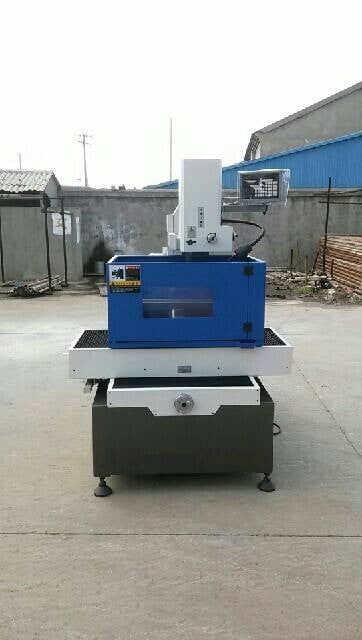
On HarsMarg machines, both fast-wire and medium-speed Wire EDM use a reciprocating, drum-stored molybdenum wire. The practical difference is the cutting sequence. The fast-wire range is positioned for single-cut machining, while the medium-speed range adds trimming cuts after the first cut to improve the result under suitable process conditions. “Medium-speed” therefore should not be read as a simple promise that the machine always cuts more slowly, and “fast-wire” does not mean it will complete every job faster.
Both processes remove material through controlled electrical discharges and are intended for electrically conductive workpieces. The correct choice depends on the drawing, material, workpiece size and weight, target tolerance and surface roughness, taper, production requirement and the amount of validation required before production.
What Do Fast-Wire and Medium-Speed Mean Here?
Fast-Wire: Reciprocating Single-Cut Wire EDM
HarsMarg's single-cut Wire EDM machines store reusable molybdenum wire on a wire drum and move it back and forth through the cutting zone. The product range is organized for applications in which one production cut can meet the required drawing, finish and process plan.
Single-cut does not mean that every model has the same accuracy, cutting rate or workpiece capacity. Travel, worktable size, maximum load, maximum workpiece thickness, wire diameter, taper capability, controller and other specifications remain model-specific. A large travel value also does not automatically prove that the machine can accept a heavier or thicker workpiece.
Medium-Speed: Reciprocating Multi-Cut Wire EDM
HarsMarg's multi-cut Wire EDM machines use the same basic reciprocating molybdenum-wire architecture but support a first cut followed by trimming cuts. A trimming cut follows a controlled path with an appropriate offset and machining parameters to remove a small remaining allowance. When the wire, working fluid, electrical settings, tension, flushing, workholding and allowance are correctly matched, trimming can improve surface finish and dimensional results.
The number of trimming cuts and the result should be confirmed for the selected controller, model and workpiece. Multi-cut capability is a process option, not a guarantee that every material, thickness and contour will reach the same finish or tolerance.
Fast-Wire vs Medium-Speed Wire EDM: Practical Comparison
| Selection Point | Fast-Wire / Single-Cut | Medium-Speed / Multi-Cut |
|---|---|---|
| Wire transport | Drum-stored, reciprocating reusable molybdenum wire | Drum-stored, reciprocating reusable molybdenum wire |
| Cutting sequence | One production cut | First cut followed by trimming cuts when required |
| Current published surface-finish reference | Ra ≤ 2.0 µm for the current single-cut range, subject to the stated process conditions | Ra ≤ 2.0 µm after the first cut and Ra ≤ 0.8 µm after trimming cuts, subject to the stated process conditions |
| Accuracy statement | Model- and test-specific; do not apply one accuracy number to the complete range | Test-piece and process-specific; trimming results must not be presented as an unconditional series-wide tolerance |
| Cycle-time comparison | Evaluate the complete first-cut cycle for the actual material, thickness and contour | Include the first cut and every planned trimming cut in the cycle-time calculation |
| When to evaluate | When the required result can be achieved with one cut and the selected model covers the workpiece | When the drawing or surface requirement justifies a planned trimming process |
The published roughness values above describe reference capability, not a result guaranteed for every job. Actual performance depends on the material and hardness, workpiece thickness and height, contour, wire condition and diameter, working fluid, electrical parameters, tension, flushing, fixture rigidity, ambient conditions and inspection method.
How Should Accuracy and Surface Finish Be Compared?
Accuracy, positioning accuracy, repeat positioning and surface roughness are different measurements. They should not be combined into a single “precision” claim. A useful comparison must identify the test piece, material, dimensions, number of cuts, wire, process settings and measurement method.
Single-Cut Reference
The current HarsMarg single-cut range publishes an optimal machined surface-roughness reference of Ra ≤ 2.0 µm. The range does not use one unconditional machining-accuracy number for every model. For example, the DK7725 page publishes a conditioned machining-accuracy reference of ≤ 0.015 mm for a Cr12, 10 mm-thick octagonal test piece under its stated workshop test conditions. That result should not be copied to other models or treated as a guarantee for a different part.
Multi-Cut Reference
The current HarsMarg multi-cut pages publish Ra ≤ 2.0 µm after the first cut and Ra ≤ 0.8 µm after trimming cuts. They also describe a specified 40 mm-high, 28 mm regular octagonal test piece for which dimensional deviation after trimming is 0.009 mm across the vertical section and 0.010 mm across the horizontal section.
These single-cut and multi-cut examples use different reference conditions and are not a controlled head-to-head test. They explain how HarsMarg states performance; they do not prove that the same values will be achieved on a customer's material, thickness or contour. Where tolerance or surface finish is critical, the quotation should define the expected process and, where appropriate, an agreed sample-cut and inspection plan.
Does Fast-Wire Always Cut Faster?
No universal answer can be given from the category name alone. Effective cutting time changes with material, thickness, contour length, corner strategy, taper, wire condition, working fluid, flushing and electrical settings. A medium-speed process may also include several trimming cuts, so the total cycle must include every pass. Conversely, a single-cut process is only the better choice when its one-cut result already satisfies the drawing.
Comparisons based on unrelated catalogue speed ranges can be misleading. Ask suppliers to compare the same material, cross-section, contour, quality target and measurement method. Cutting rate, wire transport speed and programmed feed are also different quantities and should not be treated as interchangeable.
Which Machine Type Should You Choose?
Consider Single-Cut Wire EDM When
- The required tolerance and surface finish can be met with one planned cut.
- The selected model's X/Y travel, worktable, table load and maximum workpiece thickness cover the part and fixture.
- The required taper, controller and wire specification are available in the proposed configuration.
- A direct cutting process is more important than adding trimming passes that the drawing does not require.
Consider Multi-Cut Wire EDM When
- The drawing calls for a surface or dimensional result that should be evaluated with trimming cuts.
- The part geometry, allowance and fixture permit a stable first cut followed by controlled trimming.
- The selected controller and machine configuration support the required cutting and trimming strategy.
- The total cycle time, inspection plan and expected reduction in later finishing or rework make sense for the actual job.
Neither category should be selected from the word “fast” or “medium” alone. Start with the workpiece envelope and load, then review the required process result. See the complete Wire EDM machine range before comparing individual models.
How Should Cost and Productivity Be Compared?
A credible cost comparison should use the same part and quality target. Include machine configuration, setup and programming time, total cutting time for all passes, reusable molybdenum wire, working fluid and filtration, guides and other wear items, inspection, operator time, expected rework and any secondary finishing.
Do not assume that one category always uses less energy, consumes less wire, needs less maintenance or provides a faster return on investment. Those conclusions require a defined model, process route, workload and measurement period. The most economical machine is the one that meets the drawing reliably with an appropriate complete process—not necessarily the one with the fewest passes or the most aggressive catalogue claim.
Information to Send for a Model Recommendation
For a useful technical comparison, send:
- Workpiece material and grade, including hardness when relevant
- Part drawing and maximum X/Y dimensions, thickness and weight
- Contour, corner radius, taper and any start-hole requirements
- Target dimensional tolerance and surface roughness
- Expected quantity, batch size or cycle-time target
- Required controller or automation functions
- Local voltage and frequency, installation location and destination country
- Whether a sample cut or inspection report is required before ordering
HarsMarg can use these details to compare the suitable working envelope and process route across the single-cut Wire EDM range and multi-cut Wire EDM range. Final performance and configuration should be confirmed in the technical quotation.
Frequently Asked Questions
Is medium-speed Wire EDM simply a slower version of fast-wire EDM?
No. In HarsMarg's current reciprocating-wire product system, the useful distinction is the cutting sequence: fast-wire models are positioned for single-cut machining, while medium-speed models add trimming cuts after the first cut. Actual cycle time remains application-dependent.
Can both machine types cut the same materials?
Both processes are intended for electrically conductive materials. Suitability and results still depend on the material grade, hardness, thickness, contour, flushing and selected process settings. Material name alone is not enough for model selection.
Does multi-cut automatically guarantee higher accuracy?
No. Trimming provides a process route for improving the result, but it does not guarantee one tolerance for every part. Accuracy must be evaluated with the model, workpiece, allowance, number of cuts, wire, settings, fixture and inspection method clearly defined.
When is single-cut the better choice?
Single-cut is the more direct option when one cut can satisfy the drawing and the selected machine covers the part's travel, load, thickness and taper requirements. If the target finish or dimensional result requires a planned trimming process, evaluate a multi-cut model instead.
Next Step
Send your material, drawing, workpiece dimensions and weight, target tolerance and surface finish, production requirement and local power supply. HarsMarg can then review whether a single-cut or multi-cut Wire EDM process is the more appropriate starting point and identify the model range to evaluate.
Table of Contents
- What Do Fast-Wire and Medium-Speed Mean Here?
- Fast-Wire vs Medium-Speed Wire EDM: Practical Comparison
- How Should Accuracy and Surface Finish Be Compared?
- Does Fast-Wire Always Cut Faster?
- Which Machine Type Should You Choose?
- How Should Cost and Productivity Be Compared?
- Information to Send for a Model Recommendation
- Frequently Asked Questions
- Next Step