EN
EN



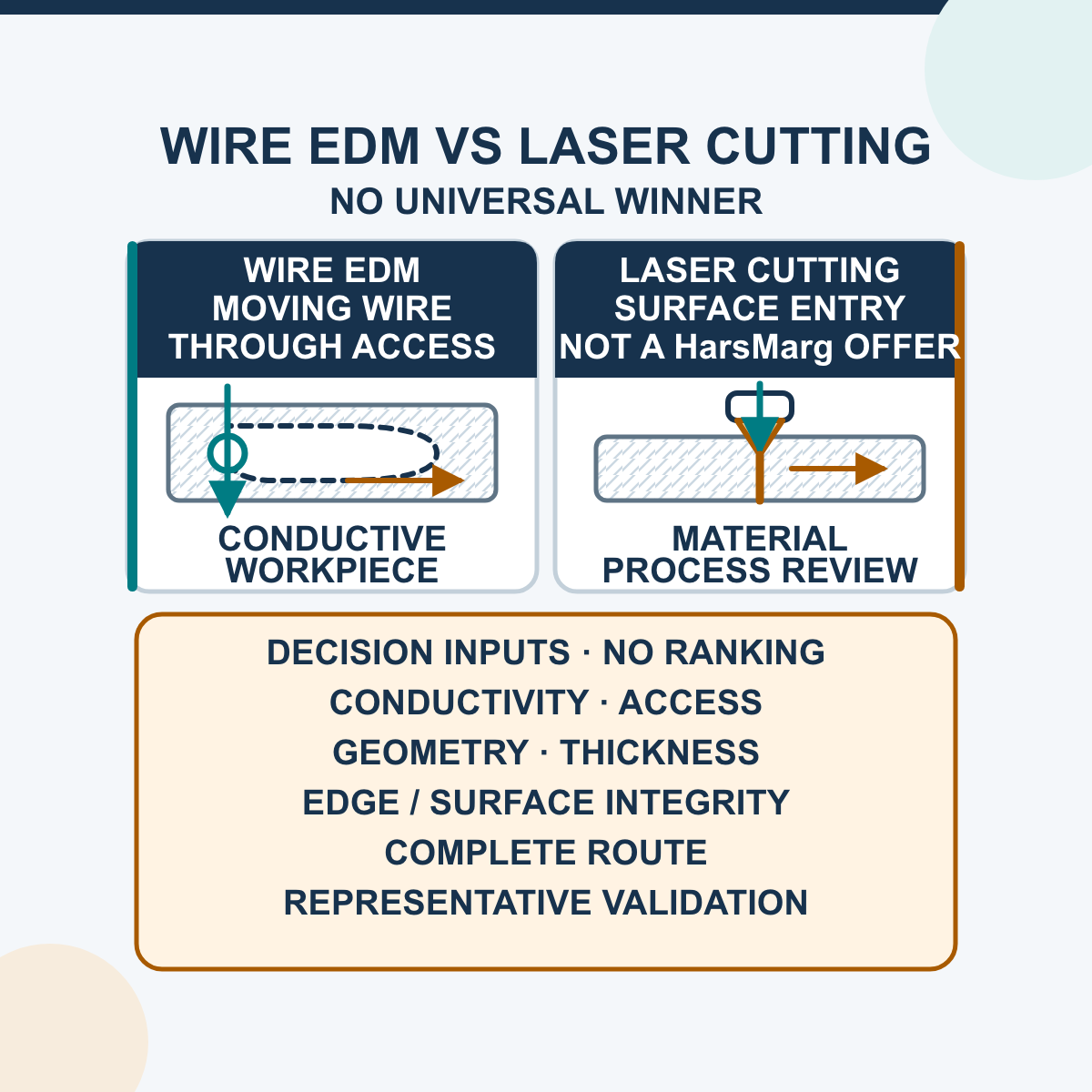
Wire EDM and laser cutting are both thermal, non-contact cutting processes, but they qualify a part in different ways. Start with Wire EDM when the workpiece is sufficiently conductive and the required contour can be produced by a wire passing through the cutting zone. Start with laser cutting when the selected laser system can couple energy into the material and reach the cut from the exposed surface. Neither rule proves the final tolerance, edge condition, cycle time or cost.
A sound purchasing comparison must use the actual material, thickness, geometry, quantity and acceptance method. It must also compare the complete route to an accepted part—not one catalogue speed, one best-case tolerance or a generic statement that one process is always more accurate or faster.
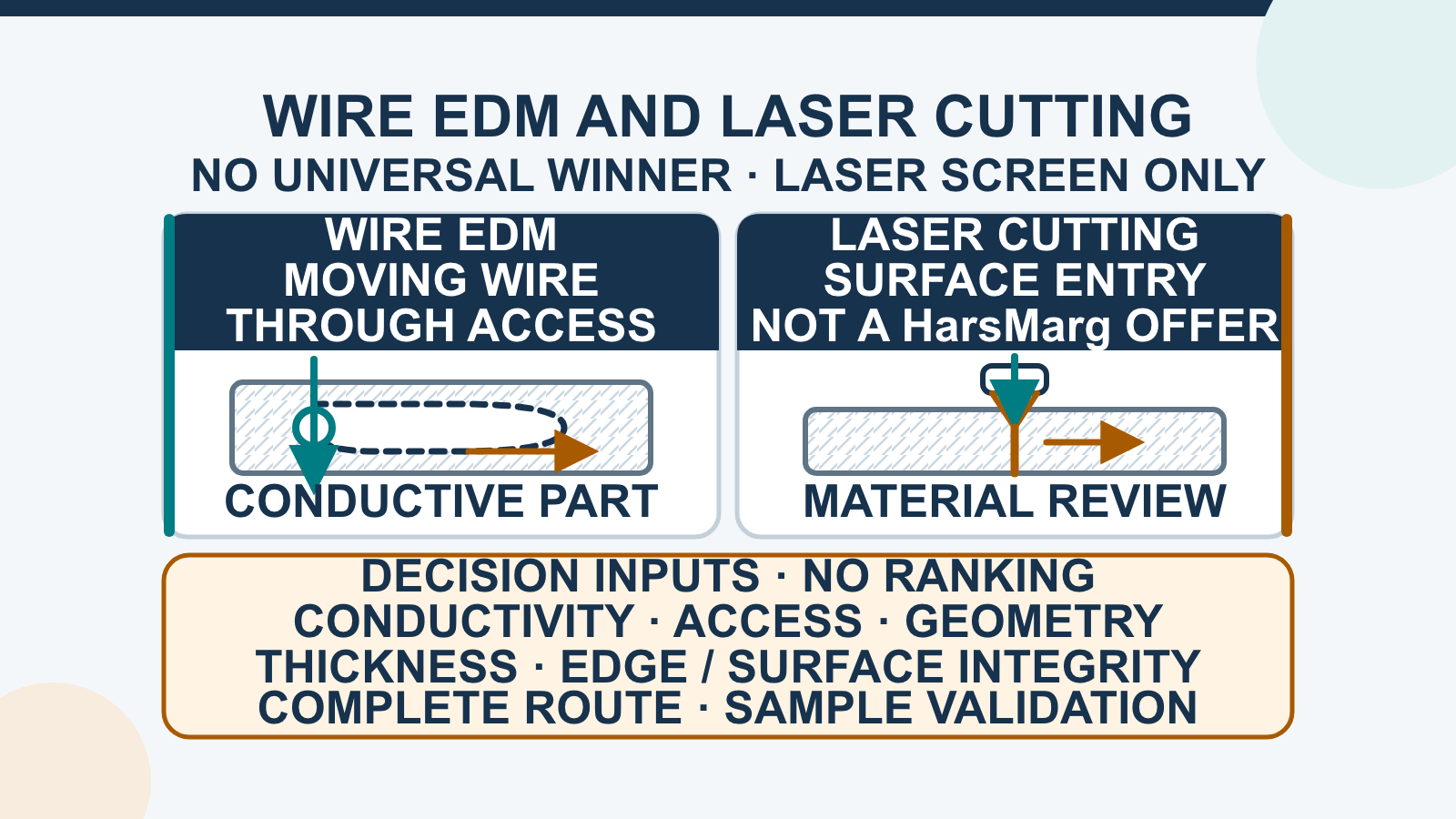
Wire EDM vs Laser Cutting at a Glance
| Decision Input | Wire EDM | Laser Cutting | Evidence to Request |
|---|---|---|---|
| Material eligibility | Workpiece must be sufficiently conductive for a stable discharge process | Depends on laser source, wavelength, power, material absorption/reflectivity, coating and selected cutting process | Exact material grade, condition, coating and representative sample result |
| Access and path | Wire must pass through the cutting zone; a closed internal contour normally needs a through start hole | Beam and nozzle need line-of-access to the cut; the system starts from an edge or uses a qualified piercing strategy | Drawing marked with entry, start/pierce location, keep-out zones and support plan |
| Thickness and envelope | Check travel, table load, guide clearance, workpiece height/thickness and flushing conditions on the named model | Check rated material/thickness for the exact laser source, optics, nozzle and gas process | Machine configuration and a sample with production-representative thickness |
| Kerf, corner and form | Wire diameter, discharge gap, guides, offsets, thickness and cut sequence influence the contour and internal radius | Focused spot, energy input, motion, pierce and gas flow influence kerf, corner and edge result | Measured profile, kerf/radius, perpendicularity or taper where applicable |
| Thermal and edge condition | Electrical discharges thermally remove material; recast/white-layer or related surface-integrity limits may matter | Melting, oxidation or vaporisation behavior depends on the laser-cutting method, material and gas; heat-affected material, oxide, burr or dross may matter | Edge/surface specification, microscopy or metallurgical method where functionally required |
| Production route | Include start-hole work, wire setup, first/rough and any trim stages, core/slug control, inspection and approved post-processing | Include programming/nesting, loading, piercing, cutting gas, part support/removal, edge treatment and inspection | Total setup-to-accepted-part time, consumables and rework—not an isolated cutting rate |
How Wire EDM Cuts
Wire EDM creates controlled electrical discharges between a moving wire electrode and a sufficiently conductive workpiece across a working gap. The programmed relative motion guides the wire along a contour while the working fluid supports gap control, cooling and debris removal. The process is non-contact in the conventional cutter-pressure sense, but it is still thermal and does not justify claims of zero heat, zero residual stress or zero distortion.
The wire needs a usable path through the cutting zone. An outside profile can begin from an accessible edge; a closed internal contour normally needs a through start hole. Workholding and core/slug release must be planned because completing a contour can change how the part is supported.
HarsMarg’s currently confirmed Wire EDM range includes single-cut and multi-cut reciprocating-wire families using reusable molybdenum wire. Do not import continuous brass/coated-wire consumption, automatic threading or disposal assumptions from another machine architecture. Use the released single-cut vs multi-cut comparison for that separate model-family decision.
How Laser Cutting Differs
Laser cutting concentrates optical energy at the workpiece. Depending on the process, material is melted, oxidised/burned or vaporised, and a gas jet helps manage or remove material from the kerf. The result depends on the actual laser source and optics, focus position and spot, power and operating mode, nozzle, cutting gas and pressure, speed, material grade/condition and thickness.
Laser cutting does not require the workpiece to conduct electricity, but that does not mean every laser cuts every material. Absorption, reflectivity, coating, thickness and the qualified process window still matter. A statement about one fibre, CO2, pulsed or other laser configuration must not be applied to all laser systems.
HarsMarg’s confirmed offer in this project is industrial EDM and related machine supply, not a verified HarsMarg laser-cutting machine line or laser job-shop service. Laser information in this guide is therefore a neutral process-screening boundary, not a claim that HarsMarg sells, operates or warrants laser equipment.
Six Questions That Usually Decide the Better Route
1. Is the material eligible for the process?
Wire EDM first requires sufficient electrical conductivity. That is only the eligibility gate: material grade, heat-treatment condition, inclusions/coatings, geometry, gap stability and thermal acceptance still influence the result. Laser suitability requires the supplier to qualify the exact material and surface for the proposed laser source, optics and cutting method.
2. Can the tool path physically reach the feature?
Wire EDM is naturally suited to through contours that a wire can enter and follow. Confirm the start point, complete wire path, guide/nozzle clearance, core/slug release and fixture stability. Laser cutting needs beam/nozzle access and a practical pierce or edge start. A hidden surface, blocked line of access or difficult part support can change the choice before accuracy is discussed.
3. What geometry and edge result must be accepted?
Do not replace a drawing with the words “high precision.” Mark the controlling profile, internal radii, kerf allowance, taper/perpendicularity, edge break, burr/dross allowance and any surface-texture requirement. For Wire EDM, state whether the quotation includes a first/rough cut only or later trim cuts. For laser, state whether oxide, discoloration, striation or post-cut edge work is acceptable.
4. Does surface integrity affect function?
Both processes apply concentrated thermal energy. Wire EDM can leave a recast layer whose significance depends on material, parameters, later processing and the application. Laser cutting can produce a heat-affected edge, oxidation or adhered/redeposited material depending on the cutting process. If fatigue, sealing, coating, welding, dielectric strength or another function is sensitive to the edge, define the inspection and allowable condition before choosing the process.
5. What is the production quantity and complete route?
Laser cutting may offer high throughput for a suitable sheet/process combination, while Wire EDM may remove mechanical cutter-load concerns and support demanding conductive through profiles. Those are screening observations, not a universal speed or cost ranking. Compare programming, nesting or start-hole work, setup, machining, gas/wire and other consumables, loading/unloading, slug or skeleton handling, inspection, post-processing, rework and yield.
6. What evidence will release the order?
When a requirement is critical or near a supplier’s quoted limit, request a representative sample cut and measured report. A catalogue value can screen a machine, but the accepted part still depends on the complete setup, process sequence and measurement method. The released Wire EDM accuracy guide explains why machine positioning data and finished-part accuracy must not be treated as the same field.
Representative Sample-Cut and Acceptance Plan
| Record | Why It Matters | Minimum Evidence |
|---|---|---|
| Representative blank | Material and thickness can change cutting behavior and edge condition | Material/grade, condition/coating, actual thickness and lot reference |
| Representative feature | A simple straight coupon may hide pierce, corner, taper or slug-release risks | Critical contour, start/pierce condition, radius, cut length and support method |
| Process identity | Prevents a best-case sample from being detached from the quoted configuration | Named machine/configuration; wire and cut stages, or laser source/optics/nozzle/gas process |
| Measurement | A result is not comparable without datum, method and sampling location | Instrument/method, datum, measured features, edge locations and report units |
| Route and time | Separates cutting time from accepted-part lead time | Programming, setup, start/pierce, cut stages, handling, inspection and post-processing |
What to Send for a Wire EDM Review
If the first screen points to Wire EDM, send:
- 2D drawing and, when useful, a 3D model with revision and units;
- material grade, heat-treatment/condition, coating and conductivity concerns;
- overall size, cut thickness/height, weight, datum and clamping surfaces;
- outside or closed internal contour, proposed start hole, required taper and core/slug plan;
- tolerance/GD&T, surface texture, edge and surface-integrity requirements with inspection method;
- quantity, desired route/cycle target, power supply, destination and required options or automation;
- whether a representative sample cut and measured report are required before acceptance.
Use the Wire EDM category to compare confirmed HarsMarg families, then send the drawing and acceptance requirements. HarsMarg can identify missing inputs and state which model functions or finished-part results require quotation review or a representative test.
Frequently Asked Questions
Can Wire EDM cut any metal?
No universal statement is safe. The workpiece first needs sufficient electrical conductivity, and the material condition, inclusions/coating, thickness, geometry, working-fluid behavior and required surface integrity still need review.
Can laser cutting process non-conductive material?
Electrical conductivity is not the laser eligibility gate, but the exact material still must be qualified for the proposed laser wavelength/source, power, optics and cutting method. Do not assume that one laser configuration processes every metal or non-metal.
Which process is more accurate?
Neither wins without conditions. Compare the actual material, thickness, geometry, machine and process configuration, cut sequence, fixturing/support, thermal/edge requirement and measurement method. Use a representative sample when the requirement is critical.
Is laser cutting always faster or cheaper?
No. Laser can be productive for a suitable material, thickness and nesting route, but a fair comparison includes setup, piercing, gas, loading/unloading, edge work and inspection. Wire EDM comparisons must likewise include start-hole work, cut stages, wire/working-fluid system, slug control and inspection. Compare total accepted-part cost and time.
Does Wire EDM avoid heat-affected material?
No. Wire EDM removes material through electrical discharges and is a thermal process. Recast/white-layer and related surface-integrity effects may need specification and inspection where they affect part function.
Does laser cutting need a Wire EDM start hole?
No wire-threading hole is required. A laser route still needs a qualified edge start or piercing method, beam/nozzle access, part support and an acceptance plan for the pierce and cut edge.
Choose from Evidence, Not a Generic Ranking
Wire EDM is not automatically the most accurate option for every part, and laser cutting is not automatically the fastest or lowest-cost route. Use the eligibility, access, edge, route and sample evidence above. For a Wire EDM equipment review, send HarsMarg the drawing, material, thickness, quantity and acceptance method rather than relying on an isolated catalogue number.