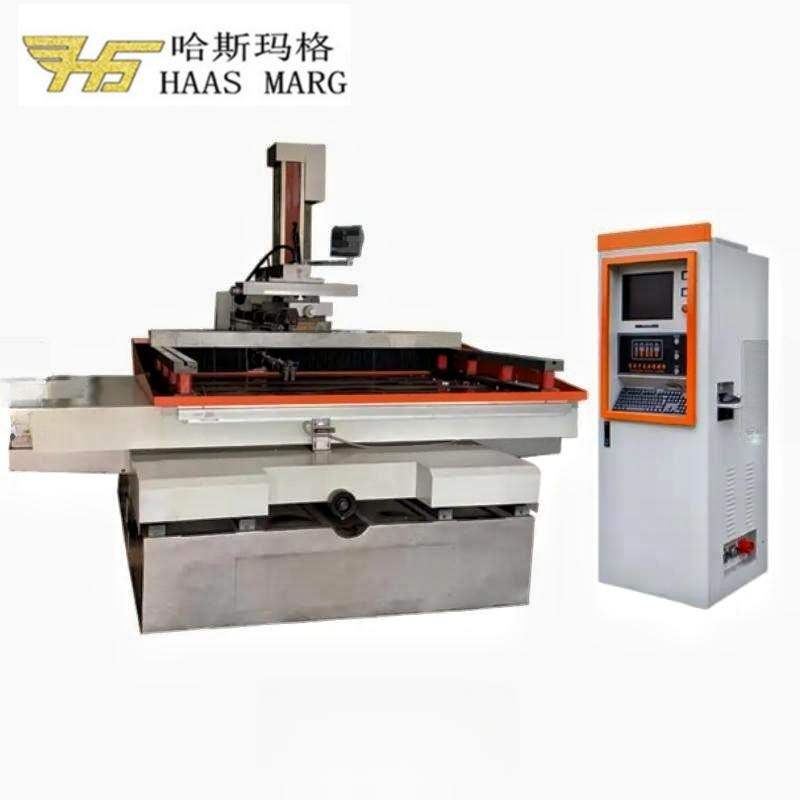
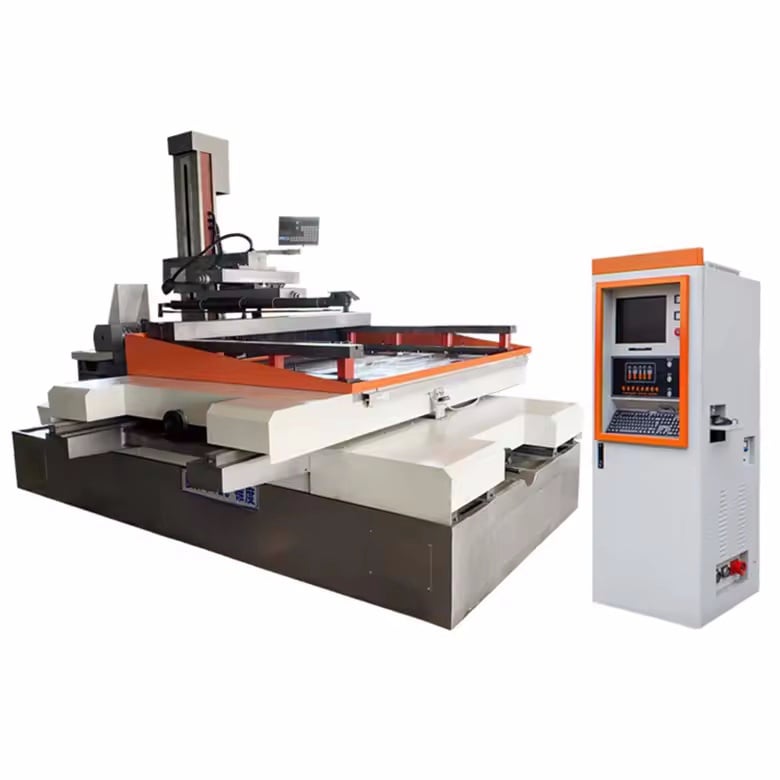
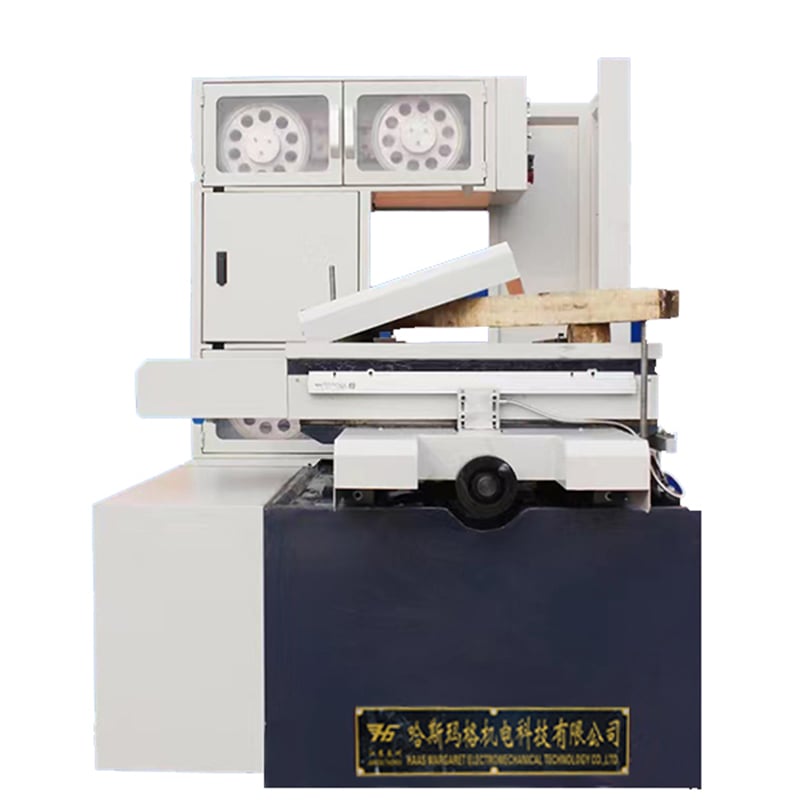
CNC wire electrical discharge machining (Wire EDM / WEDM) is a precision process for conductive materials. It removes workpiece material via instantaneous high temperature generated by pulsed spark discharge, which causes localized melting and vaporization, with eroded debris flushed away by dielectric fluid. Based on electrode wire travel mode and process characteristics, wire EDM machines are broadly categorized into medium-speed wire EDM (MS-WEDM) and low-speed wire EDM (LS-WEDM). The distinction extends far beyond cutting speed alone — they differ significantly in wire circulation, machining accuracy, surface finish, operating cost and application scenarios. Proper selection requires a comprehensive evaluation of part tolerance, material properties, part geometry, production volume and total cost of ownership.
MS-WEDM uses reusable molybdenum electrode wire running in reciprocating circulation. It features relatively low capital investment and per-piece machining cost, making it suitable for general precision molds, stamping dies, conventional mechanical parts and other applications with moderate accuracy requirements.
LS-WEDM adopts disposable electrode wires such as brass wire or zinc-coated wire, which travel unidirectionally and continuously through the machining zone at a low speed. Fresh wire is fed steadily during operation, ensuring consistent wire performance and delivering superior machining accuracy, dimensional consistency and surface finish. It is the preferred solution for high-precision progressive dies, precision stamping dies, aerospace components and high-precision mechanical parts.
Put simply, MS-WEDM is preferred for scenarios prioritizing cost and efficiency with moderate accuracy demands, while LS-WEDM is the go-to option for high precision, premium surface quality and high batch consistency. It should be noted that selection should never be based solely on the assumption that “MS-WEDM is cheap and LS-WEDM is expensive”, but driven by the final technical requirements of the part.
Machining accuracy is the primary criterion. For parts with moderate requirements on dimensional accuracy, form and position tolerance, taper control and surface roughness, MS-WEDM can meet most mold and mechanical part demands through proper parameter setting and multiple trim cuts. For parts with strict specifications on dimensional accuracy, straightness, circularity, perpendicularity, taper and surface roughness — especially those requiring consistent quality in mass production — LS-WEDM offers distinct advantages. It is not advisable to set a rigid tolerance threshold for mandating LS-WEDM; instead, decisions should be made based on part tolerance, material thickness, structural complexity and final surface requirements.
Workpiece material properties are a critical reference. Wire EDM applies to highly conductive materials such as die steel, tool steel, cemented carbide, copper, aluminum and some conductive composites. Key material considerations include electrical conductivity, structural homogeneity, heat treatment stability, residual stress level, and whether material thickness and machining area match the machine’s process capability. For die materials subjected to quenching or cryogenic treatment, residual stress must be fully relieved through proper heat treatment to reduce the risk of workpiece distortion or cracking after cutting.
Part geometry determines pilot hole requirements. Machining closed inner holes, internal cavities, contoured holes and other closed profiles generally requires pre-machined pilot holes to thread the electrode wire into the machining zone. Pilot hole position is determined by part geometry, programming path and machining process, as it directly affects machining efficiency, entry accuracy and final part quality. For open profiles that can be cut directly from the workpiece outer edge, a dedicated pilot hole is unnecessary.
Electrode wire selection shall align with process requirements. MS-WEDM typically uses molybdenum wire with diameters from 0.12 mm to 0.20 mm. The specific wire diameter depends on machine structure, workpiece thickness and machining demands — 0.18 mm molybdenum wire is not universally suitable for all MS-WEDM applications. LS-WEDM mostly uses brass wire or dedicated alloy wire, with common diameters of 0.10 mm, 0.15 mm, 0.20 mm and 0.25 mm. A smaller wire diameter does not guarantee better results; comprehensive consideration shall be given to discharge stability, machining gap, workpiece thickness, productivity and wire breakage risk. The claim that “wire diameter should not be less than 0.2 mm for high cutting speed” is inaccurate. Wire diameter shall be selected based on machine capability, workpiece conditions and accuracy requirements.
Workpiece clamping and alignment directly impact machining quality. Clamping shall ensure reliable positioning and secure holding, avoiding distortion caused by improper clamping force. After setup, inspect the workpiece datum surface, flatness, perpendicularity, and alignment between the workpiece coordinate system and machine coordinate system. In high-precision LS-WEDM, workpiece alignment accuracy directly determines final dimensional and geometric accuracy. For thin-walled parts, slender parts and workpieces with high residual stress, special attention shall be paid to distortion caused by stress relief during machining.
Wire threading, squaring and positioning are critical pre-machining steps. After threading, verify wire running stability, and adjust wire tension, wire guide system and dielectric fluid condition per machine specifications. Prior to machining, calibrate electrode wire perpendicularity, commonly done via edge finder, spark alignment or automatic machine squaring. Wire positioning can be achieved by visual inspection, spark alignment, contact edge finding, automatic edge sensing or automatic centering. Modern CNC wire EDMs are usually equipped with full automatic alignment functions, which greatly improve positioning efficiency and repeatability.
Comparison Item |
Medium-Speed Wire EDM |
Low-Speed Wire EDM |
Electrode Wire |
Reusable molybdenum wire, reciprocating travel |
Disposable brass/zinc-coated wire, unidirectional travel |
Machining Accuracy |
Medium to high precision |
High precision |
Surface Finish |
Good |
Superior, higher batch consistency |
Operating Cost |
Relatively low |
Relatively high |
Typical Applications |
General molds, conventional mechanical parts |
Precision molds, high-precision components |
Batch Consistency |
Dependent on process capability |
Distinct advantage |
The core of choosing between MS-WEDM and LS-WEDM is not which machine is “more advanced”, but whether the part’s technical requirements match the process capability of the technology. If accuracy, surface finish and consistency requirements fall within the reasonable capability of MS-WEDM, it delivers better cost-effectiveness. For high-precision molds, precision stamped parts, or products with strict dimensional, geometric and surface specifications, LS-WEDM should be prioritized. The final decision shall integrate machining accuracy, material type and thickness, part geometry, production volume, lead time, machine capability and overall machining cost to arrive at the optimal solution.
 Hot News
2026-11-04
2026-10-28
2026-10-21
2026-09-16
2026-09-09
2026-09-02

 EN