EN
EN



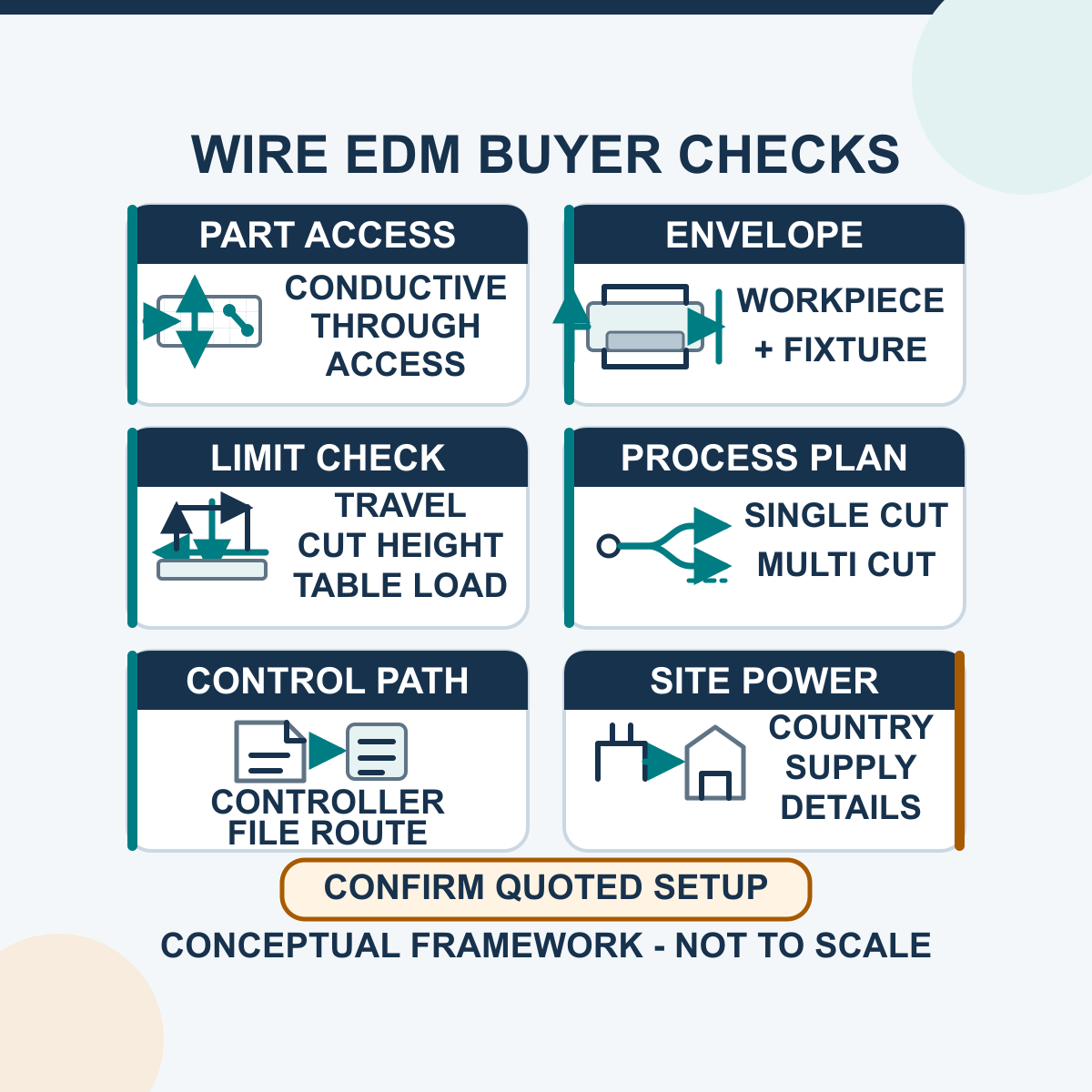
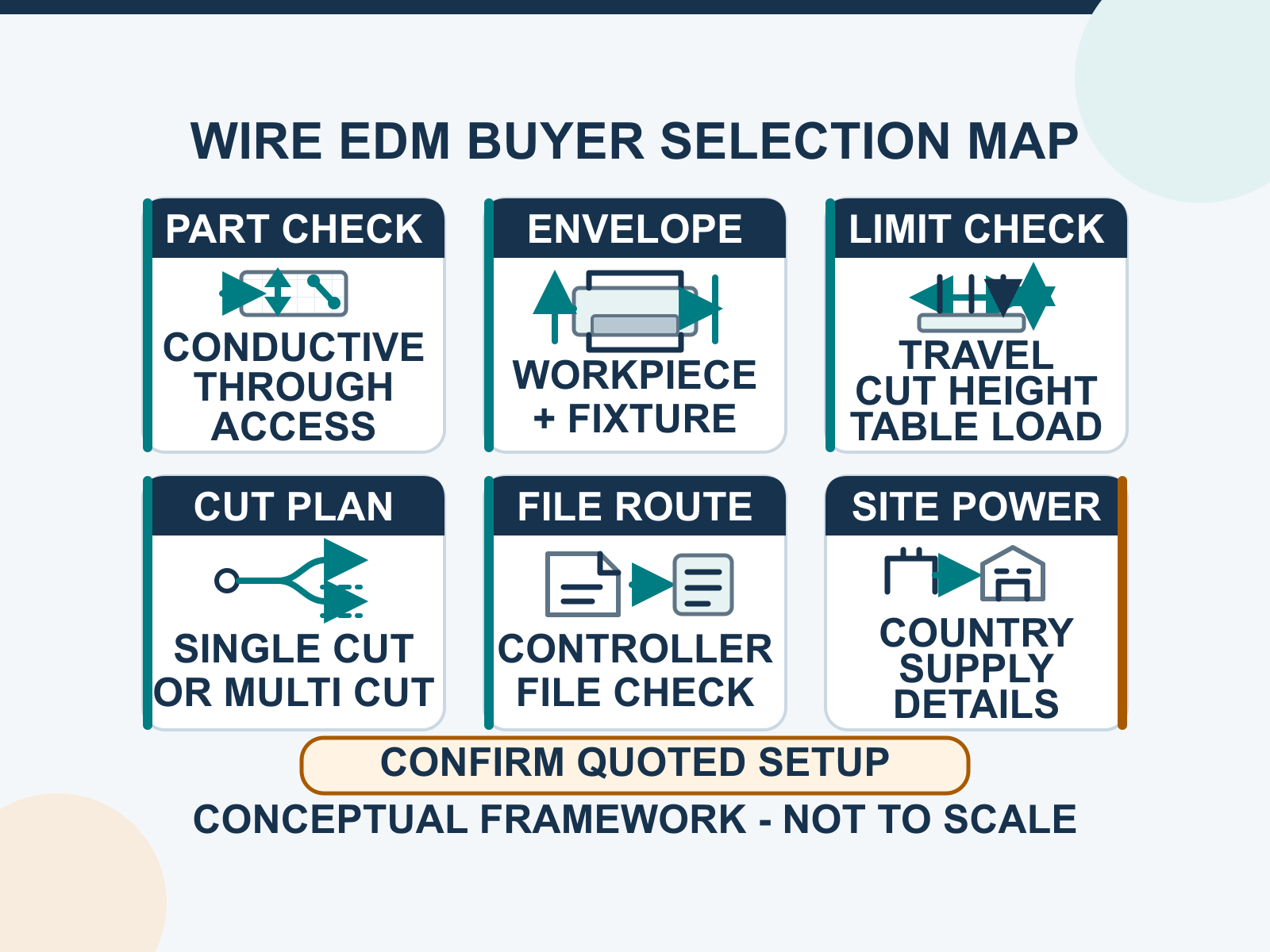
Choose a Wire EDM machine by starting with the part, not with a machine label. First confirm that the workpiece is electrically conductive and that the required profile can be cut through the material from an edge or a prepared start hole. Then match the workpiece dimensions, fixture weight, cutting thickness, contour, taper, tolerance, surface requirement, batch pattern, controller workflow and factory power supply to a specific quoted configuration.
Within HarsMarg's current Wire EDM machine range, the published single-cut machines and multi-cut machines use reusable molybdenum wire stored on a wire drum and moving back and forth through the cutting zone. A single-cut process uses one qualified production cut. A multi-cut process can add controlled trimming cuts after the first cut. Neither category is an automatic quality grade: the drawing, workpiece and validated cut plan determine the appropriate choice.
Start With a Written Job Definition
A model comparison is useful only after the buyer has defined the job. The same material name can cover different grades and heat-treatment conditions, and the same nominal part size can require different machine capacity once the blank, fixture, clamps, wire path and inspection datum are included.
| Job Input | Why It Changes the Selection | What to Send |
|---|---|---|
| Material | Wire EDM needs an electrically conductive workpiece, and the exact grade and condition affect the cut plan. | Material grade, heat-treatment condition and any coating or joined material. |
| Workpiece envelope | Axis travel alone does not prove that the blank, fixture and wire path fit the machine. | Blank length, width, height, cutting thickness, weight and fixture/clamp dimensions and weight. |
| Feature and access | An external profile may start at an edge; a closed internal profile needs a start hole and a through path. | Drawing with start location, lead-in/lead-out, core support/removal and guide clearance above and below the workpiece. |
| Quality requirement | Tolerance and finish must be attached to the feature and inspection method, not requested as a vague “high precision” label. | Feature tolerances, datum scheme, surface requirement, corner/radius limits and proposed inspection method. |
| Production and site | Batch pattern, file workflow and site power affect the quoted control, support and electrical configuration. | Parts per batch, repeat frequency, drawing/file format, operator language, country, voltage, frequency and phase. |
Step 1: Confirm That the Part Fits Wire EDM
Check electrical conductivity and material condition
Conventional Wire EDM requires a stable electrical-discharge path through an electrically conductive workpiece. Send the exact material grade and condition instead of relying on a broad label such as “steel” or “alloy.” If the finished workpiece is non-conductive, this Wire EDM selection path is not the correct starting point.
Check for a through contour and wire access
The wire must pass through the cutting zone. An external contour can normally begin from an accessible edge. A closed internal contour needs a prepared start hole that reaches through the material and allows the wire to be threaded. The buyer should also identify how the cut core or skeleton will be supported and removed. A blind pocket or cavity calls for a different process assessment rather than a larger Wire EDM machine.
If a required start hole cannot be prepared by the buyer's existing method, discuss it as a separate operation. HarsMarg's EDM drilling machine range can be reviewed independently, but the drilling method, electrode and achievable hole must be confirmed for the actual material and thickness.
Step 2: Match the Complete Workpiece Envelope
Separate travel, table, workpiece and cut-height limits
Do not select a machine from X/Y travel alone. Compare the required toolpath with axis travel, then confirm the maximum workpiece length, width and height, the usable table/opening and the maximum cutting thickness published for the selected model. Leave room for clamps, fixture plates, guide access, lead-in/lead-out motion and removal of the cut section.
Include fixture weight and load distribution
The load calculation should include the blank, fixture, clamps and any support plate, not just the finished part. Send the total estimated mass and how it will be supported. The supplier should confirm both the table-load limit and any placement or loading restriction for the proposed setup.
Step 3: Translate the Drawing Into Cutting Requirements
State tolerance and surface finish by feature
A request for “the best accuracy” is not a usable purchase specification. Mark the critical dimensions, datums, allowable geometric variation and any surface-roughness requirement on the drawing. State whether inspection applies across the complete cut height or at defined sections. Also identify corner-radius, narrow-slot and small-detail requirements that may be constrained by the approved wire and cut plan.
The quotation should not turn one catalogue value or one test piece into a guarantee for a different material, thickness or contour. For a critical result, request a representative sample cut and agree the measurement method and acceptance criteria before production approval.
Define taper with the complete geometry
A taper request should include the angle, cutting height, upper and lower contour, datum and direction. Taper capability depends on the selected machine configuration, guide arrangement, workpiece height and contour. Ask the supplier to confirm the requested geometry for the quoted model instead of comparing a maximum angle without its test height or configuration.
Step 4: Choose Single-Cut or Multi-Cut by the Process Plan
| Decision Point | Single-Cut | Multi-Cut |
|---|---|---|
| Confirmed HarsMarg wire system | Reusable molybdenum wire stored on a drum and moving reciprocally. | Reusable molybdenum wire stored on a drum and moving reciprocally. |
| Cut sequence | One qualified production cut is planned to meet the agreed requirement. | A first cut can be followed by controlled trimming cuts. |
| Selection question | Can one validated cut meet the drawing and finish requirement? | Does the drawing justify a planned first cut plus one or more qualified trimming stages? |
| Evidence to request | Model capacity, cut plan and sample/inspection evidence for the actual requirement. | Model capacity, planned allowances and trimming sequence, plus sample/inspection evidence. |
Do not choose from the words “fast” or “medium” alone, and do not assume that multi-cut automatically guarantees one result for every workpiece. For the terminology and process difference, read the dedicated single-cut versus multi-cut Wire EDM guide. For a fuller discussion of process benefits and limits, use the separate Wire EDM advantages guide.
Step 5: Match the Production, Control and Site Workflow
Describe the batch and setup pattern
State the expected number of parts per batch, how often the job repeats, whether several profiles share one blank and how frequently material or setup changes. This allows the supplier to discuss programming, fixture access, inspection and operator workflow without making an unsupported commercial-outcome claim.
Confirm the controller and file path
Send a representative drawing or file and identify the software used by the buyer. Ask the quotation to name the controller, interface language, supported input/import formats, program-transfer method, drawing-conversion workflow, backup method and included training/support. A format or function should be treated as available only when it is confirmed for the quoted controller and configuration.
Confirm country, power and installation conditions
Provide the installation country and the available voltage, frequency and phase. Ask whether the quoted machine is configured directly for that supply or needs an approved transformer or other adaptation. The technical confirmation should also cover grounding, working-fluid arrangement, ambient limits, floor/load requirements, access for delivery and commissioning responsibilities.
Step 6: Validate the Selection Before Ordering
For a critical part, use an agreed validation package instead of relying only on a catalogue description. The package should identify the proposed model/configuration, specimen material and condition, representative thickness and contour, wire and working-fluid conditions, cut stage, measurement equipment, inspection locations and acceptance criteria. If the sample differs from the production part, record the limits of that comparison.
- Freeze the latest drawing revision, datum scheme and critical feature list.
- Agree which production-representative material, thickness, contour and taper will be tested.
- Record the selected machine/configuration and the planned single-cut or first-cut-plus-trimming sequence.
- Agree the measurement method, locations and acceptance rule before the sample is cut.
- Review the measured result and process record before treating the setup as evidence for the purchase decision.
Wire EDM RFQ Checklist
- Company, contact person, installation country and requested delivery/commissioning scope
- Material grade, heat-treatment condition and any coating or joined material
- Blank length, width, height, cutting thickness and total setup weight including fixture and clamps
- Drawing and file, including revision, units, datums, tolerances, surface requirements, corner/radius limits and inspection notes
- External or closed internal contour, required start-hole location and guide access
- Taper angle, cutting height, upper/lower geometry and datum
- Parts per batch, repeat frequency and expected setup changes
- Preferred controller/interface language and the buyer's drawing/programming workflow
- Available voltage, frequency, phase and relevant site/installation constraints
- Requested sample-cut, inspection and acceptance plan for critical work
- Required documentation, training, spare parts and post-installation support
Common Selection Mistakes to Avoid
- Choosing by the largest travel without confirming usable workpiece, table, load, thickness and fixture limits
- Assuming every conductive material and thickness will produce the same speed, accuracy or finish
- Requesting an internal contour without identifying the start hole, wire path and core-removal plan
- Comparing taper angles without the test height, guide arrangement or upper/lower geometry
- Choosing single-cut or multi-cut from a marketing label instead of the drawing and qualified cut sequence
- Assuming a file format, controller function or electrical configuration is included when it is absent from the quotation
- Treating one catalogue or sample result as a guarantee for a different production part
Frequently Asked Questions
What is the first question when choosing a Wire EDM machine?
Confirm whether the exact workpiece material is electrically conductive and whether the required feature is a through contour accessible from an edge or a prepared start hole. If either condition is not met, another process assessment is required.
Should I choose a single-cut or multi-cut machine?
Choose from the qualified cut plan. A single-cut machine is the direct starting point when one validated production cut can meet the drawing and finish requirement. Evaluate multi-cut when the requirement justifies a first cut followed by controlled trimming cuts. Confirm the decision with the actual material, thickness, contour and inspection method.
Does every internal profile need a start hole?
A closed internal through-profile needs an opening through which the wire can be threaded. Send the start-hole location and planned method with the drawing. An external contour may instead start from an accessible edge.
Is axis travel enough to confirm machine capacity?
No. Also confirm the usable table/opening, maximum workpiece dimensions, cutting thickness, table load, fixture space, guide access and wire route for the selected model.
How should I compare controllers?
Use a representative buyer file and ask the supplier to demonstrate or document the import/programming path. Compare the named controller, supported formats, transfer and backup method, interface language, included functions, training and support. Do not assume that features from another model or controller are included.
When is a sample cut appropriate?
A representative sample is appropriate when a critical tolerance, surface requirement, taper or difficult geometry materially affects acceptance. Agree the material, specimen, machine/configuration, process stage, measurement method and acceptance criteria before testing.
Next Step: Send the Job, Not Just a Model Name
Review the complete HarsMarg Wire EDM range, compare the current single-cut and multi-cut categories, then send your drawing and RFQ checklist to HarsMarg. The technical reply should identify the proposed model and configuration, the confirmed capacity and site requirements, any excluded or optional item, and the validation route for the requested part.
Table of Contents
- Start With a Written Job Definition
- Step 1: Confirm That the Part Fits Wire EDM
- Step 2: Match the Complete Workpiece Envelope
- Step 3: Translate the Drawing Into Cutting Requirements
- Step 4: Choose Single-Cut or Multi-Cut by the Process Plan
- Step 5: Match the Production, Control and Site Workflow
- Step 6: Validate the Selection Before Ordering
- Wire EDM RFQ Checklist
- Common Selection Mistakes to Avoid
- Frequently Asked Questions
- Next Step: Send the Job, Not Just a Model Name