EN
EN



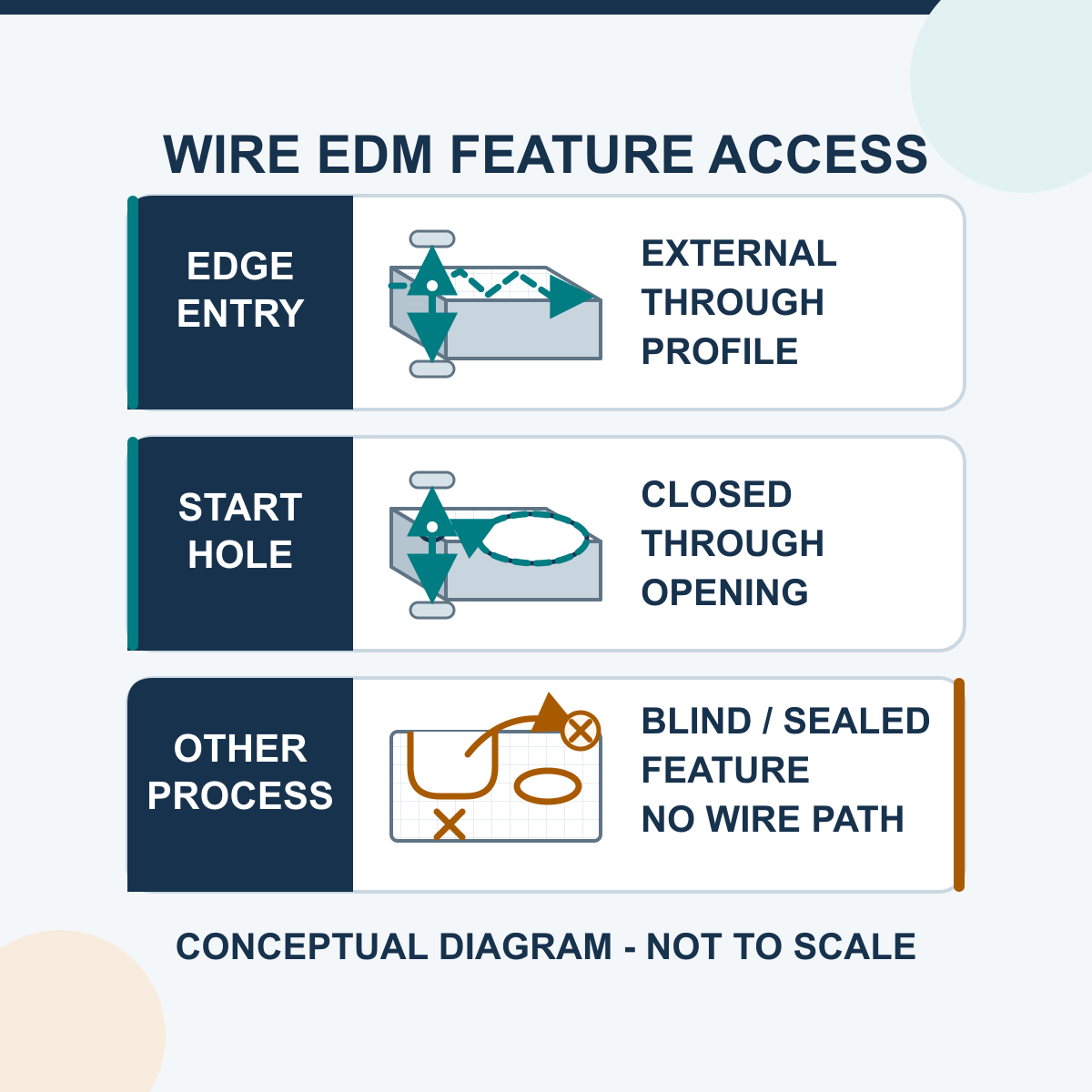
Wire EDM is mainly used for external and internal through-profiles in electrically conductive workpieces when a moving wire can reach the complete cut path. Typical candidate features include detailed outside contours, closed internal profiles with a prepared start hole, narrow slots, small practical internal radii and selected tapers. The drawing must still be reviewed for material, thickness, wire access, guide clearance, workholding, slug control, acceptance requirements and machine capacity.
The process should not be selected from an industry label alone. A turbine component, mold insert, electronic part or production tool may contain a suitable through-profile, an unsuitable blind cavity, or several features that need different processes. The useful question is therefore not simply “Which industries use Wire EDM?” but “Which features on this part can a wire enter, follow and complete under a defined inspection plan?”
Which Part Features Suit Wire EDM?
| Part Feature | Initial Process Fit | What Must Be Confirmed |
|---|---|---|
| External through-profile | Often a Wire EDM candidate because the wire can enter from an accessible stock edge. | Lead-in/lead-out, datum, stock support, release sequence, thickness, radius, tolerance and inspection. |
| Closed internal through-profile | A candidate when a start hole allows the wire to pass through the workpiece. | Start-hole position and size, upper/lower guide access, flushing, core support and removal. |
| Narrow slot or detailed profile | May fit when the complete slot is a through-feature and the wire/kerf can satisfy the drawing. | Slot width, wire diameter, discharge gap, offset, corner behavior, flushing and cut stability. |
| Small internal radius | May suit Wire EDM better than a larger rotating cutter when access and conductivity are suitable. | The radius must remain compatible with wire radius, discharge gap, programmed offset, thickness and corner control. |
| Controlled taper or different upper/lower profiles | Possible only when the selected machine configuration and guide motion support the required geometry. | Top and bottom geometry, angle direction, reference height, workpiece thickness, guide/nozzle clearance and model-specific taper range. |
| Repeated conductive plate or insert profiles | A qualified program and setup may support repeat work with the same controlled input conditions. | Drawing revision, stock condition, datum, fixture, wire/fluid condition, program revision and inspection plan. |
| Blind cavity or enclosed internal passage | Not a normal Wire EDM feature because the wire cannot follow a complete through-path. | Review die-sinking EDM, milling or another process suited to the geometry. |
| Small or deep hole | Usually a drilling question, not a Wire EDM profile question. | Review conventional drilling or EDM drilling; the same hole may also serve as start access for a later Wire EDM contour. |
A through-profile does not automatically become a good Wire EDM job. A simple open cut may be more economical by sawing, milling, laser cutting or another process. Wire EDM becomes a stronger candidate when the profile, material condition, low conventional cutting-load requirement or internal access makes those alternatives less suitable. Compare the complete accepted-part route rather than an isolated catalogue cutting rate.
How Wire Access Changes the Application Decision
External Profiles Can Start from an Edge
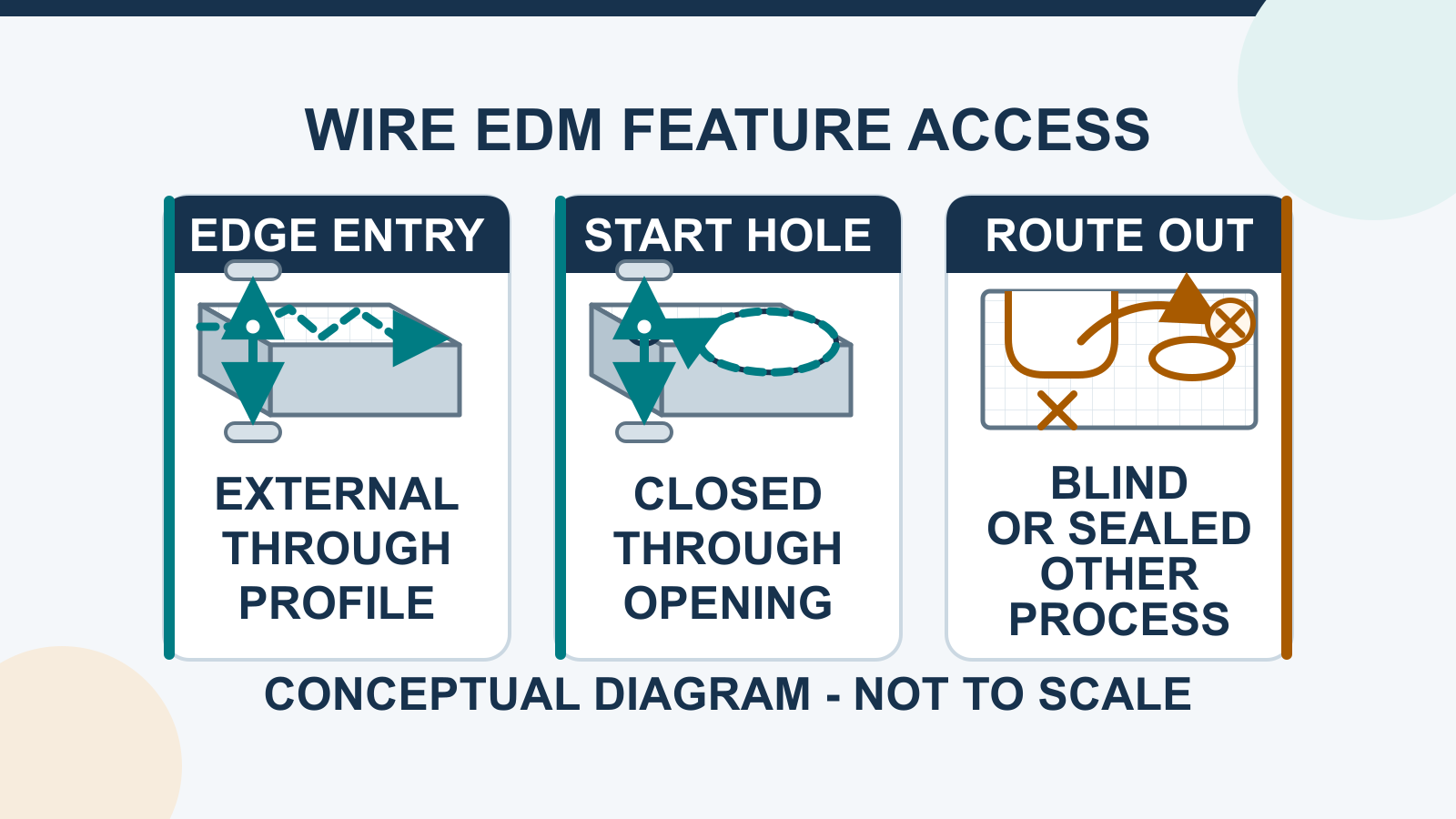
For an outside contour, the wire can normally enter from an accessible edge of the stock. The drawing and process plan still need a lead-in/lead-out location, datum strategy, support for the retained part and skeleton, and a safe final release sequence. Low conventional cutting force does not remove the risk of movement caused by residual stress or loss of support.
Closed Internal Profiles Normally Need a Start Hole
The start hole must pass through the workpiece and be positioned so the wire can reach the programmed contour. Its size and location must be practical for the wire route, and the part/fixture must allow guide access and flushing above and below the cut. The released core must remain controlled until it can be removed safely.
Blind and Sealed Features Need Another Route
A standard moving wire cannot terminate inside the workpiece to form a blind three-dimensional cavity or arbitrary enclosed channel. These features should be reviewed for die-sinking EDM, milling, drilling, additive manufacture or a combined process route. A component can contain both Wire EDM features and features assigned to other operations.
Common Manufacturing Uses—Screened by Feature
The examples below describe plausible feature types. They are not records of HarsMarg customer projects or evidence of aerospace, automotive, electronics or other industry certification.
| Application Family | Features That May Fit | Features That Need Separate Review |
|---|---|---|
| Tool, die and mold components | Punch outlines, die openings, profile inserts, gauges and through-slots in suitable conductive material. | Blind mold cavities, ribs, pockets, cooling channels, punch/die clearance and functional surface-integrity limits. |
| Precision mechanisms and electronics tooling | Detailed through-outlines, narrow through-slots, conductive fixture elements and profile components. | Non-conductive substrates, coatings/composites, very thin sections, burr/edge criteria and cleanliness requirements. |
| Aerospace and energy part features | Selected conductive through-contours, slots, cut-off profiles and test-coupon geometry where access is suitable. | Internal cooling passages, blade qualification, fatigue-critical surfaces, traceability and any regulated approval. |
| Automotive and general industrial production | Production-tool profiles, conductive inserts, fixtures, gauges and repeat through-features. | Injector orifices, internal oil channels, safety-system validation, cycle target and production acceptance evidence. |
| Maintenance and replacement work | Recreated conductive profiles when a controlled drawing, material and datum definition are available. | Unknown material, worn sample-only geometry, undocumented clearance and claims of interchangeability without inspection. |
Industry names do not replace process qualification. For a critical feature, define the acceptance criteria, inspect a representative result and retain the material, program, offset, cut-stage and measurement records required by the buyer's quality system.
Single-Cut or Multi-Cut for the Application?
HarsMarg's current single-cut and multi-cut Wire EDM machines use reusable molybdenum wire stored on a wire drum and moving back and forth through the cutting zone. A single-cut process uses one qualified production cut. A multi-cut process can add controlled trimming cuts after the first cut when the drawing and trial result justify the extra stages.
Do not select between them from the industry name or an unsupported precision label. Compare the feature, material, thickness, required radius/taper, dimensional and surface acceptance, total cut sequence and inspection plan. The Wire EDM advantages and limitations guide explains the two families and the conditions behind published performance references.
What Wire EDM Does Not Prove by Itself
- Conductivity is necessary, not sufficient. Grade, condition, coating/composite structure, thickness, thermal behavior, flushing and economics still affect feasibility.
- A fine wire does not create a mathematically sharp inside corner. Wire radius, discharge gap, offset, material, thickness and corner control set the practical result.
- Low conventional cutting load does not mean zero movement. Fixture support, residual stress, wire behavior, flushing and slug release remain relevant.
- Wire EDM is a thermal process. Recast/white layer, heat-affected material, residual stress or microcracking may need an agreed limit and inspection where functionally important.
- The process name does not guarantee tolerance, finish, speed or cost. These outcomes require the named machine, material, geometry, setup, cut sequence and measurement context.
- A CNC program does not prove unattended production. Threading, restart, monitoring, handling and other functions must be confirmed on the exact quoted configuration.
What to Send for an Application Review
A useful review begins with the part and acceptance plan. Send:
- a controlled 2D drawing and a usable profile file; include a 3D model when assembly context or upper/lower geometry matters;
- material grade, conductivity-relevant condition, heat treatment or hardness, coating/composite information and stock condition;
- overall dimensions, thickness/height, weight, quantity and accessible datum surfaces;
- the feature type, edge entry or start-hole location, lead-in/lead-out, available upper/lower guide clearance and proposed core/slug handling;
- minimum radius, slot width, straight/tapered requirement, top/bottom geometry and any controlled witness or edge condition;
- dimensional, form, position, surface-texture and surface-integrity requirements with measurement locations and methods;
- the accepted current process, cycle target and whether a representative sample test is required;
- destination country, power supply and any specifically required control, axis, handling or monitoring function.
The model review must then compare the drawing with machine travel, table load, workpiece/cut height, taper and guide configuration, controller/file needs, working-fluid system and site requirements. A representative trial is appropriate when a requirement is critical, close to a published boundary or affected by material/geometry that has not been qualified.
Frequently Asked Questions
What types of parts can Wire EDM cut?
Wire EDM is primarily a candidate for electrically conductive parts containing an accessible external or internal through-profile. The drawing must still be checked for material, wire access, workpiece thickness, guide clearance, radius/taper, support and acceptance requirements.
Does every internal Wire EDM profile need a start hole?
A closed internal contour normally needs a through start hole so the wire can be installed or threaded into the cut. An external profile may begin from an accessible stock edge.
Can Wire EDM make a blind cavity or internal cooling channel?
Not as a standard through-wire operation. A blind cavity generally points toward die-sinking EDM or milling, while an enclosed passage may require drilling, additive manufacture or another combined route. Review the actual geometry rather than assigning it to Wire EDM from the component name.
Can Wire EDM cut any metal?
No universal claim should be made. Sufficient electrical conductivity is required, but grade, heat treatment, coating or composite structure, thickness, thermal behavior, working fluid, flushing and acceptance criteria also affect suitability.
Can Wire EDM cut a hole?
It can cut a closed through-profile that functions as an opening when a usable start hole and wire path exist. A small or deep hole used as a finished feature or start hole is normally reviewed as a conventional-drilling or EDM-drilling task.
Does Wire EDM avoid heat-affected material?
No. Wire EDM removes material through electrical discharges and is a thermal process. Where surface integrity matters, define the allowed recast/white layer, heat-affected material, residual-stress or microcrack condition and the inspection method.
Can Wire EDM produce a taper?
A taper or different upper/lower profile may be possible when the selected machine configuration provides the required guide motion and clearance. State both profiles, angle direction, reference height and thickness, then verify the result for the exact model and setup.
Request a Drawing-Based Wire EDM Review
Review the HarsMarg Wire EDM range, including the single-cut and multi-cut families. Then send HarsMarg your drawing, material, feature access and acceptance requirements. The review can identify which features fit Wire EDM, which need another process, which machine capacities must be checked and whether a representative sample test is needed.
Table of Contents
- Which Part Features Suit Wire EDM?
- How Wire Access Changes the Application Decision
- Common Manufacturing Uses—Screened by Feature
- Single-Cut or Multi-Cut for the Application?
- What Wire EDM Does Not Prove by Itself
- What to Send for an Application Review
- Frequently Asked Questions
- Request a Drawing-Based Wire EDM Review