EN
EN



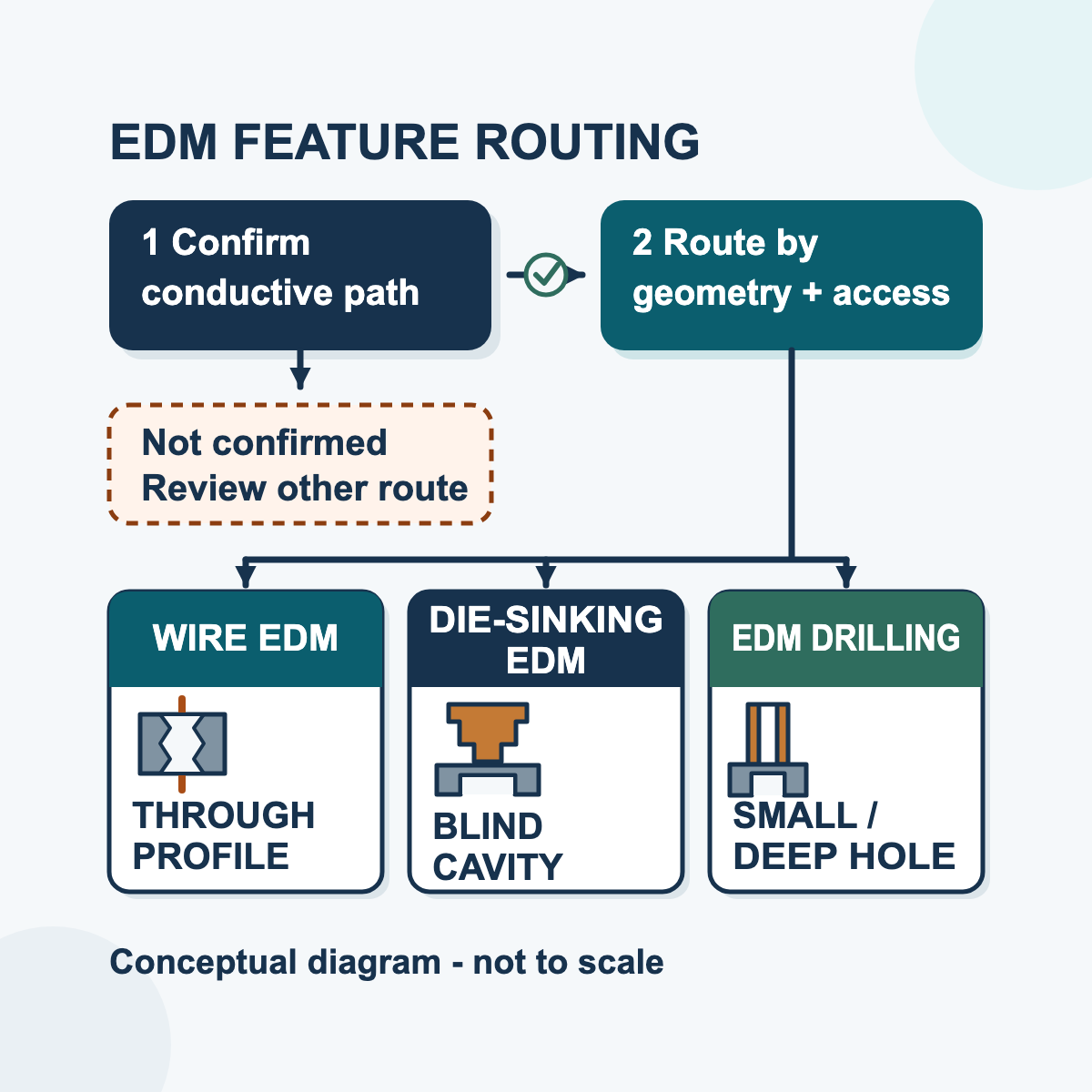
The best candidates for standard EDM are workpieces that provide a stable electrically conductive path from the machine connection to the area being machined. Conductive steels and tool steels, stainless steels, nickel-based alloys, titanium alloys, aluminum and copper alloys, cemented carbide, and some conductive sintered or composite grades can all be evaluated. However, a material-family name alone does not prove machinability, speed, accuracy, finish or commercial suitability.
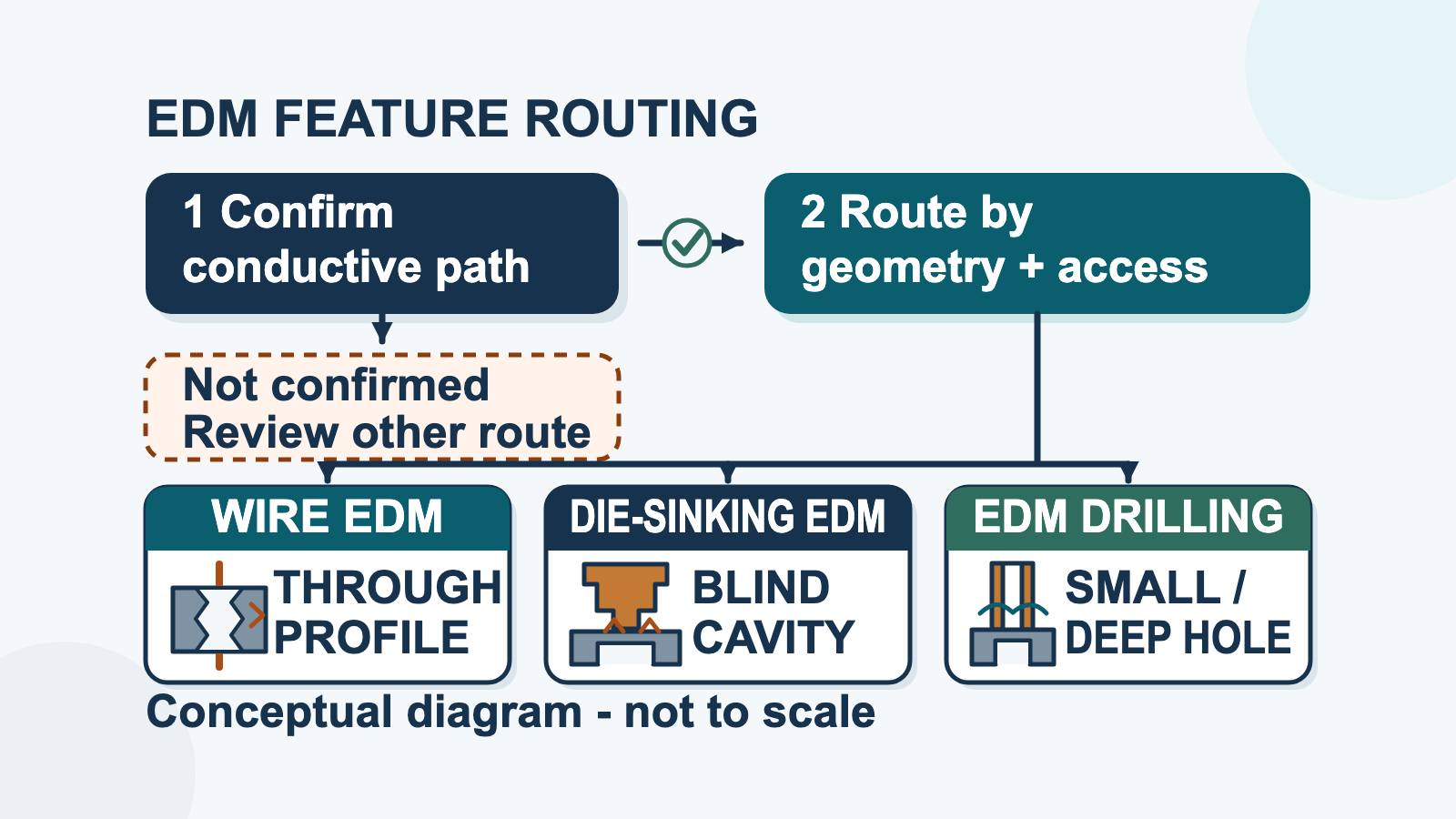
After conductivity is confirmed, geometry selects the process. Wire EDM cuts a path or profile with a moving wire electrode. Die-sinking EDM uses a shaped electrode for a blind cavity or three-dimensional negative form. EDM drilling commonly uses a rotating tubular electrode with flushing to make small or deep holes. The exact grade, heat treatment or temper, coating, binder, interfaces, feature access and inspection requirements then determine whether a practical process can be qualified.
Ordinary glass, plastic, stone and insulating ceramic are not direct workpieces for standard EDM. Some specialized conductive ceramics, composites or assisted research processes exist, but they must not be treated as a general HarsMarg capability without review of the exact grade and machine configuration.
Start With the Conductive-Path Test
EDM removes material through controlled electrical discharges across a machining gap. That circuit needs a sufficiently conductive workpiece connection and a conductive route to the feature being machined. Hardness alone is not the eligibility test: a hardened conductive steel can remain an EDM candidate because the process does not rely on a mechanically loaded cutting edge.
Conductivity is only the first gate. It is not a universal ranking of machining speed or surface quality. Two materials with similar conductivity can respond differently because of composition, microstructure, heat treatment, thermal properties, section thickness, electrode or wire, dielectric condition, flushing and the selected generator conditions. For this reason, this guide does not use one resistivity threshold or one settings table for every HarsMarg model.
Check the actual current path, not just the material certificate. Heavy oxide, paint, scale, plating, contamination, adhesive layers or an interrupted conductive phase may affect the work connection or the discharge zone. For a brazed, coated, laminated or multi-material assembly, identify every material and interface along the intended feature.
Choose the EDM Process by Feature Geometry
| EDM process | Electrode and motion | Best geometry starting point | Access and selection checks |
|---|---|---|---|
| Wire EDM | A moving wire electrode follows a programmed cut path | External profiles, through slots, punch/die contours and straight or tapered through-cuts | An external cut can start from an edge; an enclosed internal contour normally needs a start hole. Confirm thickness, taper, minimum inside radius, fixture/slug support and work envelope. |
| Die-sinking EDM | A shaped electrode advances into the workpiece and transfers a negative form | Blind cavities, mold details, ribs, pockets and three-dimensional features that a wire cannot trace | Confirm electrode design/material, cavity depth, corner/rib requirements, flushing access, workpiece/electrode mass and tank/travel limits. |
| EDM drilling | A tubular electrode commonly rotates while working fluid is delivered through it | Small or deep holes, start holes for Wire EDM and localized holes in conductive parts | Confirm hole diameter, depth, angle, entrance/exit condition, blind or through requirement, breakthrough risk, electrode access and flushing path. |
The same material may be a candidate for all three processes while requiring a different machine for each feature. For example, a conductive tool-steel blank may use Wire EDM for an outside profile, die-sinking EDM for a blind mold cavity and EDM drilling for a small deep hole. Material compatibility does not make those processes interchangeable.
Common Conductive Material Families to Evaluate
| Material family | Preliminary EDM view | Information required before approval |
|---|---|---|
| Conductive carbon, alloy and tool steels | Common EDM candidates, including hardened conditions when the exact job is qualified | Grade/standard, heat-treatment state, hardness when relevant, scale or coating, residual-stress concern, section and required feature |
| Stainless steel and nickel-based alloy | Conductive grades can be evaluated for profiles, cavities or holes | Exact grade and condition, thickness/depth, regulated or service requirement, corrosion/cleaning controls and any specified surface-integrity limit |
| Titanium alloy | A candidate when the grade is conductive and the selected process matches the feature | Grade, heat treatment, part function, surface-integrity/recast requirements, cleaning/contamination limits and validation method |
| Aluminum, copper, brass and bronze alloys | Conductive candidates; high conductivity does not automatically predict the fastest or best result | Exact alloy and temper, oxide/coating and electrical-contact surface, thin-feature support, post-cut cleaning and dimensional requirement |
| Cemented carbide and conductive sintered material | Potential candidates when the binder/conductive phase provides a suitable circuit | Grade, binder type/content, porosity, conductivity, edge/chipping risk, fluid compatibility and customer-defined binder/surface acceptance |
| Conductive ceramic, PCD or composite grade | Special-review category; a family name or conductive coating is not enough | Supplier grade, composition and conductive phase, measured or certified conductivity, layer/interface map, test coupon and required inspection |
| Glass, plastic, stone and ordinary insulating ceramic | Not direct candidates for standard EDM | Select a suitable non-EDM process unless a documented specialist process and compatible equipment are separately qualified |
This table is a screening guide, not a list of materials already qualified on every HarsMarg model. Final acceptance belongs to the exact material, feature, machine configuration, process route and measured sample result.
Material Hardness Is Not the Whole Decision
EDM has no conventional cutting edge pushing through the workpiece, so increasing hardness does not create the same mechanical tool-load problem found in milling, turning or drilling. This is one reason EDM is considered for conductive hardened steels, carbide and difficult alloys.
That does not mean hardness or material condition can be ignored. Heat treatment can change microstructure and residual stress; releasing a profile can reveal distortion that was already stored in the blank. Electrical and thermal properties, binder phases and surface condition also influence process development. Record the production condition rather than testing an annealed coupon and assuming it validates a hardened part.
Cases That Need Additional Review
- Coated or oxidized parts: identify coating material/thickness and where the work connection reaches clean conductive material.
- Brazed, laminated or multi-material parts: map each interface crossed by the cut, cavity or hole; do not assume one conductive layer validates the complete path.
- Sintered and composite grades: provide binder, conductive phase, porosity and grade-specific data. Nominally similar grades may not behave the same.
- Thin walls or flexible sections: include the fixture, support and slug-release plan; non-contact erosion does not prevent a residual-stress or release-distortion problem.
- Safety-critical or regulated parts: define recast layer, microcrack, contamination, dimensional, roughness and traceability requirements separately. EDM feasibility does not establish aerospace, medical or other process approval.
- Hazardous or reactive materials: review the current safety data, dielectric/fluid compatibility, ventilation, waste and site controls before any sample work.
A Six-Step EDM Material Selection Check
- Name the material exactly. Record the specification, grade, supplier condition, heat treatment or temper, hardness when relevant, coating and binder/composite construction.
- Confirm a conductive circuit. Verify that the workpiece connection and the complete intended discharge region are sufficiently conductive for the selected machine/process.
- Classify the feature. Choose a wire-cut profile, a shaped-electrode cavity or a tubular-electrode hole; do not choose from material name alone.
- Check physical access and capacity. Compare overall size, weight, section thickness, depth, start-hole/access route, travel, tank/work envelope, fixture and flushing access with the selected model.
- Define measurable acceptance. State dimensions, datum, tolerance, taper/profile, corner or hole requirements, roughness and any surface-integrity or regulated-process limit.
- Validate a representative sample. Use the actual grade and production-relevant geometry/condition. Keep the machine, electrode or wire, dielectric/flushing, program/pass strategy and inspection result traceable.
After Wire EDM has been selected, use the separate Wire EDM material trial and setup guide to plan a representative coupon and controlled validation. HarsMarg's current single-cut and multi-cut families use reciprocating molybdenum wire, so advice written for one-way consumable brass-wire systems should not be copied without machine-specific review.
For a plain-language explanation of the discharge process before comparing equipment, see How Electric Discharge Machining Works.
What to Send for an EDM Material and Process Review
To discuss material suitability and the correct machine family, send the following through the HarsMarg inquiry form:
- material specification, exact grade, supplier certificate or composition when available;
- heat treatment, temper, hardness, coating, binder or composite/layer construction;
- 2D/3D drawing with overall size, weight, datum and the exact feature to machine;
- for Wire EDM: thickness, open-edge/start-hole route, taper, minimum inside radius and slug/support plan;
- for die-sinking EDM: cavity dimensions/depth, corners/ribs and electrode information if already designed;
- for EDM drilling: hole diameter, depth, angle, blind/through condition and entrance/exit requirements;
- target tolerance, profile/position, roughness and surface-integrity or regulated-process limits;
- production quantity, desired validation/sample plan and available sample material;
- destination country, power supply and any loading, automation or inspection requirement.
Frequently Asked Questions
Does a material have to be electrically conductive for EDM?
Yes for standard EDM. The workpiece must support controlled electrical discharges through a suitable circuit to the machining region. Do not infer suitability from appearance, hardness or a conductive surface coating alone.
Does higher electrical conductivity always mean faster EDM?
No. Conductivity helps determine whether a discharge process is feasible, but it does not by itself predict cutting speed, electrode/wire behavior, surface finish or dimensional result. The exact material, geometry, machine, electrode or wire, dielectric/flushing and approved process conditions must be considered together.
Can hardened steel be machined after heat treatment?
A conductive hardened steel can be an EDM candidate. Use the actual production grade and heat-treatment condition for validation, and inspect for the drawing requirements plus any specified distortion, recast-layer or surface-integrity limits.
Can the same material use Wire EDM, die-sinking EDM and EDM drilling?
Potentially, yes. The material may pass the conductivity gate for all three, while feature geometry selects the process: a through profile for Wire EDM, a blind cavity for die-sinking EDM or a small/deep hole for EDM drilling. Each route still needs machine-capacity and sample validation.
Can standard EDM directly machine glass, plastic or insulating ceramic?
No. These materials do not provide the conductive workpiece circuit required by standard EDM. A specialist assisted process should not be assumed to be available on HarsMarg equipment; select another cutting process or request a documented technical review.
Does a successful trial qualify a regulated production part?
Not automatically. A trial can establish feasibility under recorded conditions, but production approval may also require repeatability evidence, calibrated inspection, surface-integrity testing, cleaning, traceability and customer or regulatory acceptance.
Table of Contents
- Start With the Conductive-Path Test
- Choose the EDM Process by Feature Geometry
- Common Conductive Material Families to Evaluate
- Material Hardness Is Not the Whole Decision
- Cases That Need Additional Review
- A Six-Step EDM Material Selection Check
- What to Send for an EDM Material and Process Review
-
Frequently Asked Questions
- Does a material have to be electrically conductive for EDM?
- Does higher electrical conductivity always mean faster EDM?
- Can hardened steel be machined after heat treatment?
- Can the same material use Wire EDM, die-sinking EDM and EDM drilling?
- Can standard EDM directly machine glass, plastic or insulating ceramic?
- Does a successful trial qualify a regulated production part?