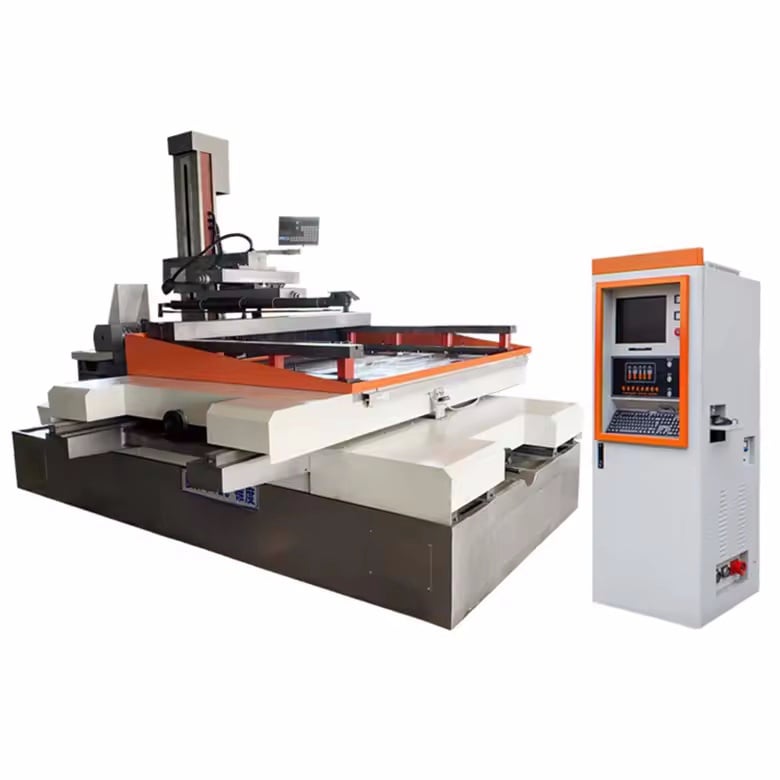
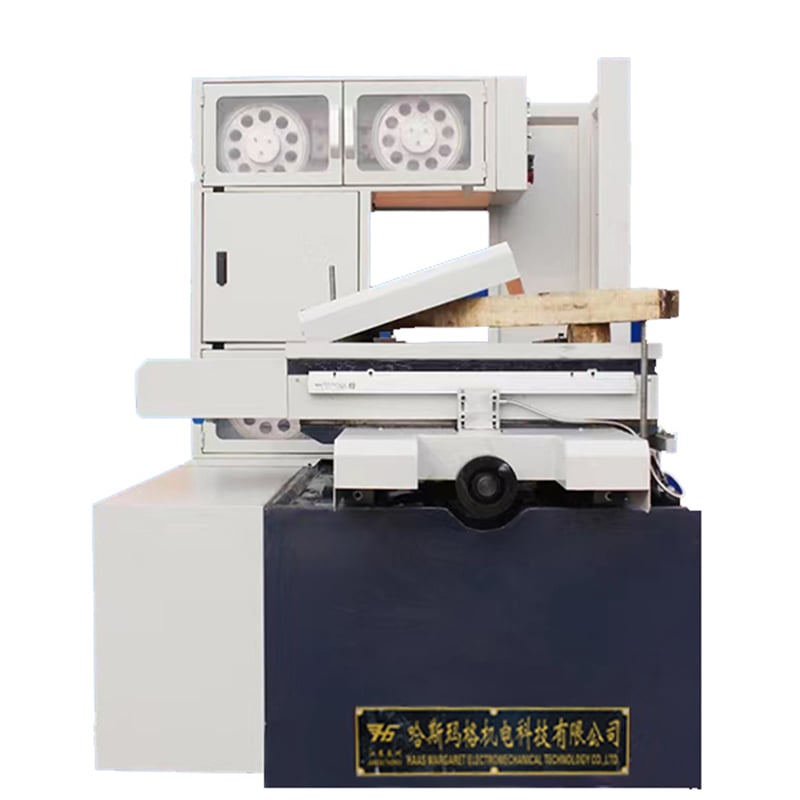
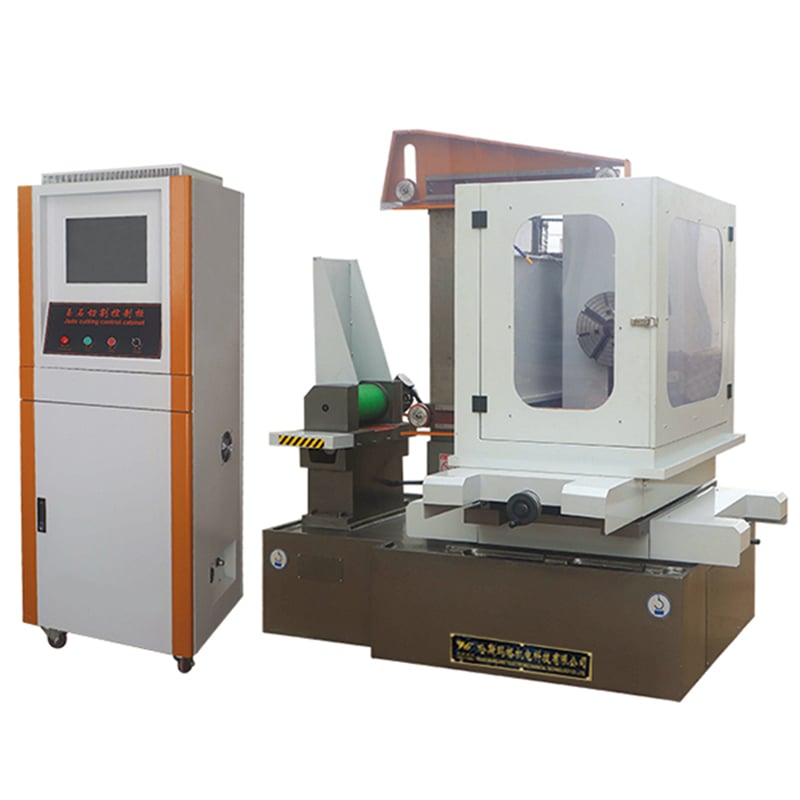
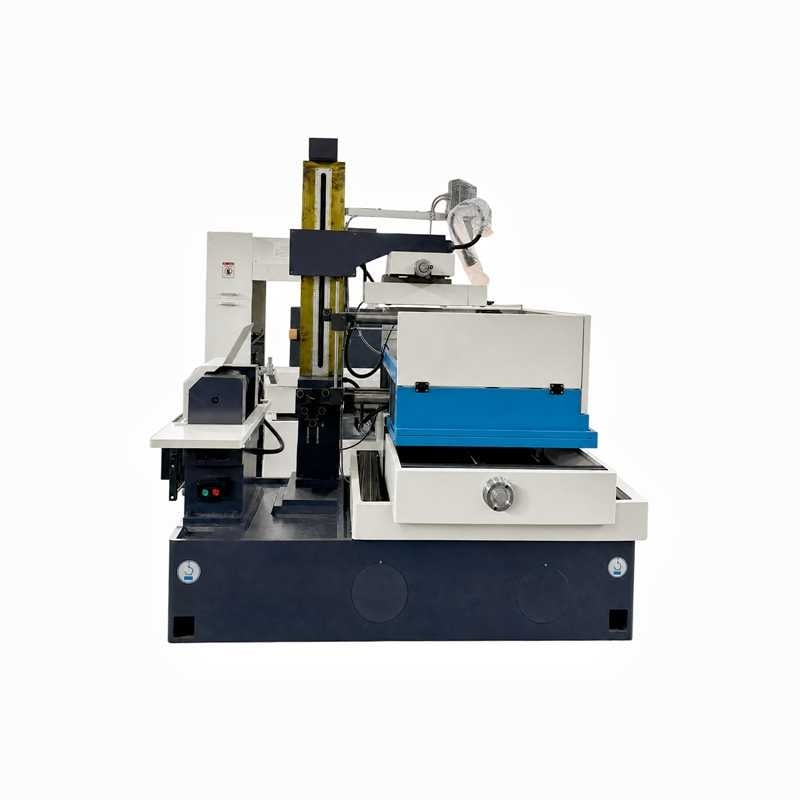
HarsMarg medium-speed multi-cut Wire EDM uses reciprocating molybdenum wire, a first rough cut and one or more controlled trimming cuts. The later cuts follow model-specific process conditions and adjusted path/offset compensation so that the remaining allowance is progressively reduced and the surface and dimensional result can be improved.
“Medium-speed” is not a globally standardized performance class defined by one wire-speed range. On this website, it identifies HarsMarg's reciprocating-wire, multi-cut product family. The required number of cuts and the result depend on the exact machine, controller technology, workpiece, wire, setup, environment and inspection method.
In a reciprocating-wire machine, the molybdenum electrode wire travels back and forth through the cutting zone. A single-cut process completes the profile in one cutting pass. A multi-cut process intentionally plans a rough cut and subsequent recuts along controlled trajectories. Those later cuts are commonly called trimming or skim cuts.
The benefit does not come from wire speed alone. It comes from managing the remaining allowance, discharge and servo condition, wire behavior, fluid/debris condition and path compensation as a sequence. A later pass cannot automatically correct an unstable rough cut, unsuitable setup, worn wire or an error caused by material movement.
The first pass establishes the profile and removes most of the material. Its programmed trajectory includes the wire radius, working gap and the allowance required by the selected cutting technology. Rough-cut stability matters because bow, corner error, poor debris evacuation, workpiece movement or an interrupted discharge condition may remain difficult to correct later.
The first recut follows an adjusted trajectory to remove part of the remaining allowance. The controller's approved technology determines the offset and process condition for the actual material, thickness, wire and target. It should not be replaced by a universal wire-speed or electrical recipe copied from another machine.
If the drawing and measured result require another cut, the remaining allowance and compensation are adjusted again using the machine's supported technology. More passes add cycle time and wire exposure and are not automatically better. Stop the sequence when the qualified process meets the stated dimensional and surface requirements.
| Stage | Primary Purpose | What Must Be Controlled | Decision Gate |
|---|---|---|---|
| Rough cut | Create the profile and leave the planned trimming allowance | Stable discharge, wire travel/tension, fluid and debris removal, clamping, corner/profile behavior and rough offset | Is the profile stable enough for the planned recut sequence? |
| First trim | Reduce remaining allowance and improve the surface/profile result | Model-specific trim technology, offset, wire condition, thermal state and consistent gap condition | Does inspection meet the drawing, or is another supported trim justified? |
| Further trim | Remove a smaller planned allowance where the requirement needs it | Updated offset/technology, wire and fluid condition, part stability and repeatable measurement | Does the measured gain justify the added cycle time and process exposure? |
Trajectory compensation is important, but it does not determine accuracy by itself. A credible machining result must connect the following variables to the actual test and inspection record.
| Variable | Why It Matters | What to Record or Confirm |
|---|---|---|
| Material and condition | Conductivity, heat treatment, inclusions and residual stress affect cutting stability and part movement | Grade, hardness/condition, heat treatment and stock preparation |
| Thickness and geometry | Tall sections, changing thickness, corners, small radii and interrupted profiles alter gap and wire behavior | Actual cut height, contour, radii, taper, entry/start hole and clamping position |
| Wire system | Diameter, wear, tension and reciprocating-travel stability affect the gap and trajectory | Wire specification, installed condition, tension method, guide/contact condition and replacement rule |
| Discharge, servo and fluid | The electrical condition, feed response and debris evacuation interact; one setting cannot be optimized in isolation | Machine technology ID/revision, working-fluid condition, filtration, nozzle/flow arrangement and alarms or interruptions |
| Compensation and machine condition | Wire radius, working gap, remaining allowance, axis condition and thermal stability affect the final contour | Offset by pass, verified machine condition, warm-up/environment and any correction applied |
| Inspection | A number has no comparable meaning without the feature, direction, datum, instrument and sampling rule | Measured feature, datum, direction/section, instrument, surface-filter/cutoff where relevant and acceptance rule |
The current DK7750C/T product page reports Ra ≤ 2.0 µm after the first cut and Ra ≤ 0.8 µm after trimming cuts. These are model-level published values, not a promise for every material, thickness, profile or inspection setup.
For a specified 40 mm-high, 28 mm regular-octagonal test piece, the page also reports dimensional deviation after trimming of 0.009 mm across the vertical section and 0.010 mm across the horizontal section. These values must not be rewritten as a universal ±0.009 mm series accuracy. A production acceptance value requires the same level of context for the selected model and workpiece.
HarsMarg's current Wire EDM range includes single-cut and multi-cut reciprocating-wire machines. Continuous-feed Wire EDM commonly uses a one-way consumable wire system. These architectures differ in wire handling, process technology, consumables and production workflow, but a machine should not be selected from a universal “fast, medium or slow” performance table.
Compare the actual work envelope, table load, cut height, wire and controller, required tolerance and Ra, geometry, pass/cycle plan, maintenance, consumables, inspection and total operating conditions. For the current HarsMarg category distinction, see single-cut vs multi-cut Wire EDM.
C and T identify bed-structure variants within the current HarsMarg multi-cut range. The T-type structure offers a modest improvement in structural stability and can be considered when the job has more demanding stability requirements. TI is an integrated T-type form. These labels do not change the basic rough-and-trim principle.
Do not convert this structural distinction into an unconditional accuracy claim. Compare the quoted machine configuration, work envelope, table/load limits, workpiece, environment and inspection result. The DK7740C/T and DK7750C/T pages show two current size points; use the multi-cut Wire EDM category for the wider range.
For a meaningful process review or sample cut, provide:
Use representative stock and geometry whenever a result will become a purchase or production acceptance condition. Do not use an unrelated competitor sample or a different HarsMarg model's result as the acceptance value.
No. On the HarsMarg site, the meaningful distinction is the reciprocating molybdenum-wire system combined with a planned rough cut and controlled trimming cuts. One wire-speed number does not define the complete process.
There is no universal pass count. It depends on the drawing, material, thickness, geometry, rough-cut result, selected model technology, target surface and total cycle-time requirement. Validate the sequence on a representative part.
No series-wide guarantee is made here. Ra ≤ 0.8 µm is the published after-trimming value referenced for the DK7750C/T. Confirm the selected model, material, thickness, wire, process and inspection condition in the quotation or sample test.
No. Material movement, poor clamping, unstable discharge, excessive bow, wire or guide problems and unsuitable offsets may limit what a later pass can correct. Rough-cut stability is part of the final-quality plan.
Not automatically. HarsMarg identifies the T-type as offering a modest structural-stability advantage for more demanding stability requirements. Accuracy still depends on the complete machine condition, workpiece, process, environment and inspection.
Send the drawing, material and condition, size and cut height, required tolerance and Ra, inspection method, production quantity, power supply and destination. HarsMarg can compare the current work envelopes and identify which performance point requires a representative sample cut or factory inspection record. Submit your multi-cut Wire EDM application for review.
 Hot News
2026-09-16
2026-09-09
2026-09-02
2026-08-26
2026-08-19
2026-08-13

 EN
EN