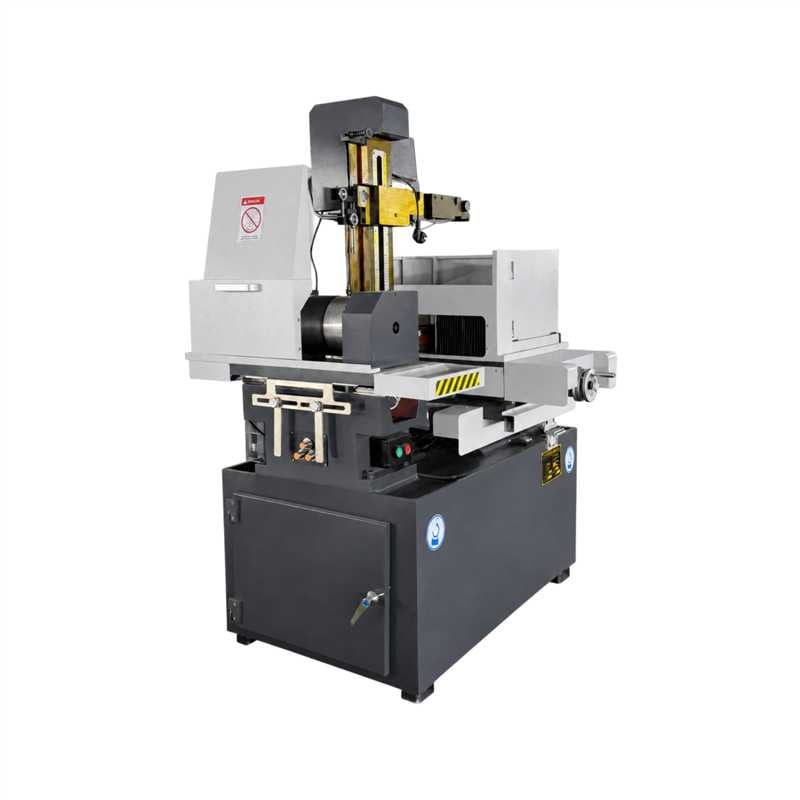
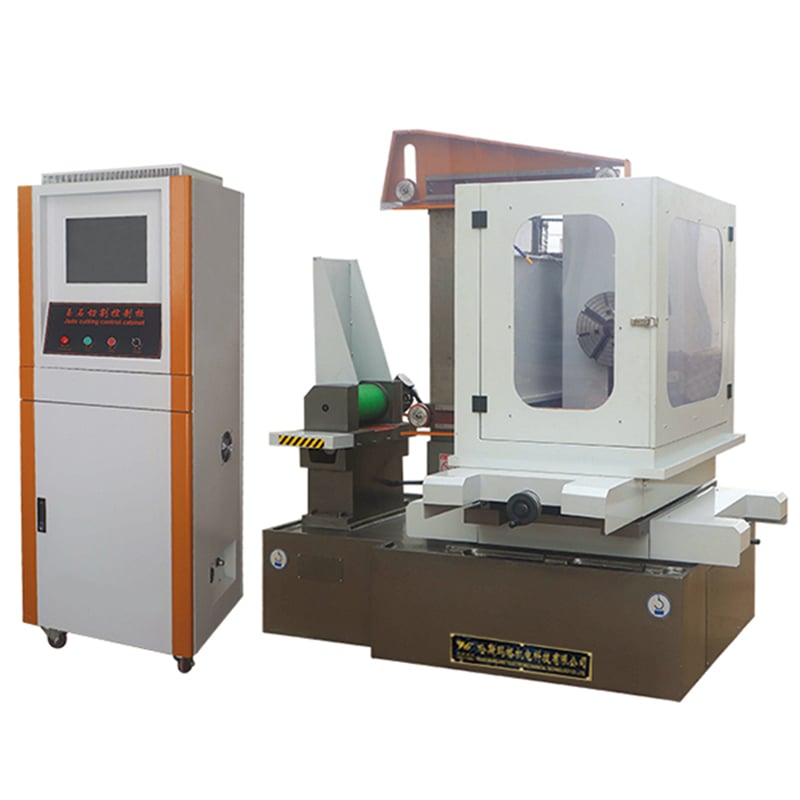
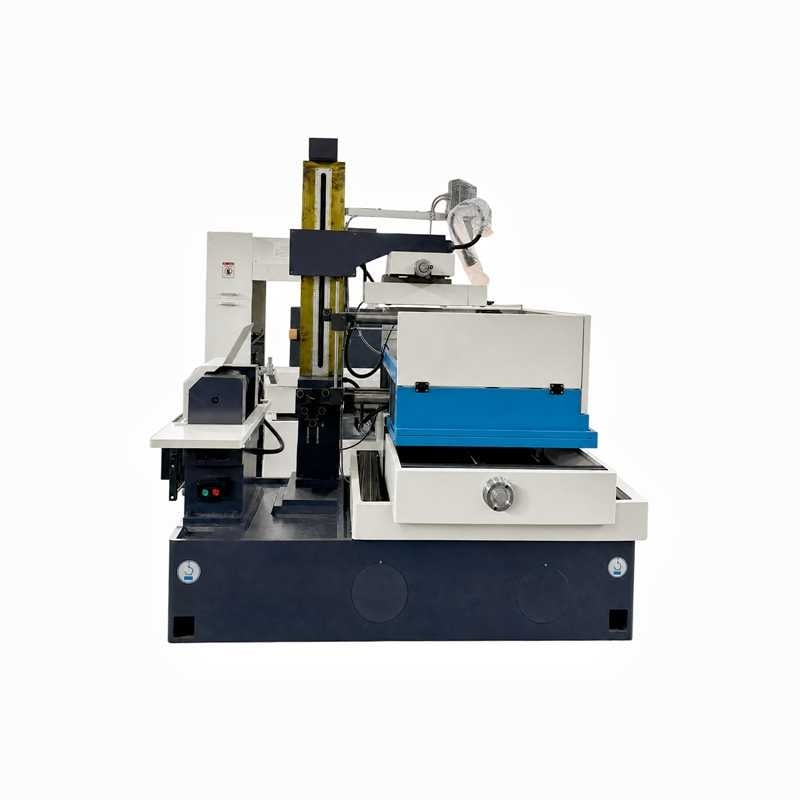
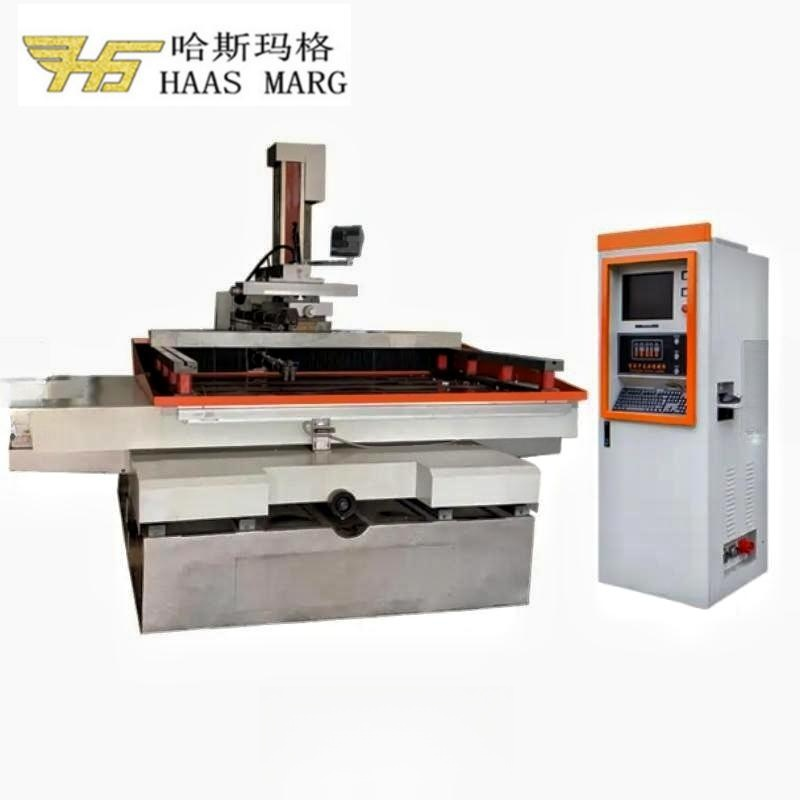
Wire electrical discharge machining (Wire EDM or WEDM) cuts a programmed profile by generating controlled electrical discharges across a small gap between a moving wire electrode and a workpiece. The process is normally used on electrically conductive material and does not depend on a conventional cutting edge.
The name “Wire EDM” does not define one machine architecture or one accuracy class. Wire path, generator, dielectric system, guide and tension condition, workpiece height, material, pass strategy, taper, setup and inspection method all affect the result. A buyer should therefore compare the actual wire system and process plan before comparing headline performance numbers.
The machine maintains a controlled working gap between the wire and workpiece. Pulsed discharges remove small amounts of material, while the dielectric system cools the cutting zone, carries away debris and allows the gap to recover between pulses. CNC motion guides the programmed path and the servo system responds to the condition of the gap.
Because the wire is not a conventional cutting tool, Wire EDM generally applies much lower average cutting force than milling or sawing. That does not mean the setup is force-free or distortion-free. Clamping, wire tension, fluid flow, thermal effects, residual stress in the stock and release of an internal slug can still change the part or interrupt the cut.
Wire EDM is a thermal process. Surface integrity can include a recast or altered layer, and the required edge, roughness and metallurgical condition must be stated and inspected when functionally important. Conductivity is also essential to the standard process; hardness alone does not determine machinability.
| Process Route | Wire and Motion | Cutting Strategy | What to Confirm |
|---|---|---|---|
|
Reciprocating single-cut Often called high-speed or fast-wire WEDM in China |
Reusable molybdenum wire travels back and forth between the wire-storage drum and guide system | One principal profile cut, with settings selected for the required balance of productivity and finish | Travel, table load, thickness, wire range, taper, stated roughness/accuracy condition, controller and sample-cut result |
|
Reciprocating multi-cut Often called medium-speed WEDM in China |
Reusable molybdenum wire uses a reciprocating transport system | A rough cut establishes the profile; one or more trim passes use revised discharge and path compensation to improve the result | Number of passes, compensation method, C/T/TI structure, test specimen, cut time and measured post-trim result |
|
Continuous one-way Wire EDM Often called slow-wire WEDM in China |
Consumable brass or coated wire is supplied from a spool and passes through the cutting zone in one direction | Main and finish-cut technologies are selected for the named material, wire, height and quality target | Wire compatibility and consumption, dielectric system, threading, pass plan, maintenance, application technology and lifecycle cost |
These labels describe process routes, not a universal ranking. A multi-cut reciprocating machine may be the practical choice when reusable molybdenum wire, acquisition cost and improved finish through trim passes fit the job. A continuous one-way machine may be selected where its technology database, wire system, automation and validated finish/accuracy fit the requirement. Compare parts and total process needs, not translated category names alone.
See the current HarsMarg single-cut Wire EDM range and multi-cut Wire EDM range. For a detailed terminology explanation, read Fast vs Medium-Speed Wire EDM: Single-Cut vs Multi-Cut.
Axis terminology should be read from the specific machine drawing and controller configuration:
A machine should not be called “four-axis” or “five-axis” solely because a generic Wire EDM diagram shows these letters. Confirm which axes are powered, CNC-controlled and interpolated; their travel; the permitted taper at a stated workpiece height; guide/nozzle requirements; and the controller/CAM workflow.
A single performance value is not meaningful unless the metric and test are defined. “Machining accuracy” may refer to a test-piece contour result, while “positioning accuracy” describes axis motion under a stated measurement standard. Surface roughness also needs the parameter, sampling direction, cutoff/evaluation settings and measurement location. Cutting speed can be reported as area per time, path feed or cycle time; these are not interchangeable.
A useful sample-cut record should include:
HarsMarg model pages may publish values for a named machine, but the quotation and representative sample determine whether a target can be accepted for the buyer's part. Do not transfer a value from one model, material or pass plan to an entire process category.
| Factor | Why It Matters | What to Record or Inspect |
|---|---|---|
| Material and height | Change discharge behavior, debris evacuation, heat flow, straightness and cut time | Grade, heat treatment, conductivity, section height and interrupted/stacked features |
| Wire path and condition | Guide alignment, wire wear, diameter, tension and contacts influence cut stability and geometry | Wire specification, guide/contact condition, tension procedure and maintenance findings |
| Discharge and servo settings | Alter material-removal rate, gap stability, wire-break risk and surface condition | Approved technology/parameter revision and changes made during qualification |
| Fluid, filtration and flushing | Affect dielectric recovery, cooling and removal of eroded particles | Approved fluid, observed condition, filters, nozzle position and setup-specific flow |
| Geometry and workholding | Corners, tapers, internal slugs, weak sections and residual stress can change the path or release behavior | Drawing, datum, start hole/edge, slug-support plan, clamps and inspection sequence |
Wire EDM is commonly evaluated for punches and dies, mold inserts, gears and splines, narrow slots, conductive carbide tooling, extrusion/profile features and other conductive components with difficult contours or heat-treated hardness. It can produce through profiles from an accessible edge or from a start hole for an internal contour.
Aerospace, medical, electronics and other regulated or high-value sectors use Wire EDM in the wider industry. These are process examples—not proof that HarsMarg supplied a named customer, holds a sector approval or has qualified a specific regulated part. Such claims require a traceable machine, material, drawing, test and quality record.
Wire EDM is not the correct process merely because a material is hard. The part must suit the electrical process, wire access, start method, flushing, workholding, geometry and required surface integrity. Where these conditions do not fit, milling, grinding, laser processing, sinker EDM or another method may be more appropriate.
Automatic wire threading, technology databases, CAD/CAM transfer, probing or on-machine measurement, remote monitoring and unattended sequences are available on some industry Wire EDM systems. Their presence, supported wire range, recovery behavior, interface and licensing vary by machine and configuration.
Do not infer these functions from the term “CNC Wire EDM.” For a HarsMarg purchase, request the named controller, included software, axis configuration, program-transfer method, alarm/recovery behavior and optional equipment in the formal quotation. A website trend article is not a configuration sheet.
To compare machines on the same basis, send:
Start with the HarsMarg Wire Cutting Machine range, then compare the confirmed work envelope, load, thickness, wire system and process plan. For benefits and limits, see Wire EDM advantages, limitations and machine selection.
No. Standard Wire EDM normally requires an electrically conductive workpiece and a workable wire path, start method, flushing condition and fixture. Hardness may be less limiting than for a cutting tool, but it is not the only selection factor.
Trim passes can improve dimensions and surface finish after the rough cut, but the actual result still depends on the machine, material, height, wire condition, parameters, compensation, setup and measurement. Compare a representative test, not the category name alone.
No. U/V travel and interpolation are model-specific. If taper or different top/bottom profiles are required, confirm the actual axes, travel, guide arrangement and permitted taper at the stated workpiece height.
No. CNC describes programmed motion/control; threading, recovery, monitoring and unattended functions must be separately listed and validated for the quoted configuration.
Send the drawing, material, workpiece size and weight, cutting height, tolerance, roughness, taper, target cycle time, lot size, power supply and destination. HarsMarg can compare the current single-cut and multi-cut models and identify which result requires quotation-level confirmation or a representative sample test. Submit your Wire EDM application for review.
 Hot News
2026-09-16
2026-09-09
2026-09-02
2026-08-26
2026-08-19
2026-08-13

 EN
EN